
The cooperative hunting of orcas
30 September 2025

Orcas are apex marine predators renowned for their intelligence and complex hunting strategies. A recent study published in Current Biology has revealed previously unknown mechanisms of their cooperative hunting - particularly in shallow waters off Norway, where orcas specialise in catching herring.
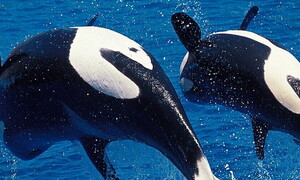
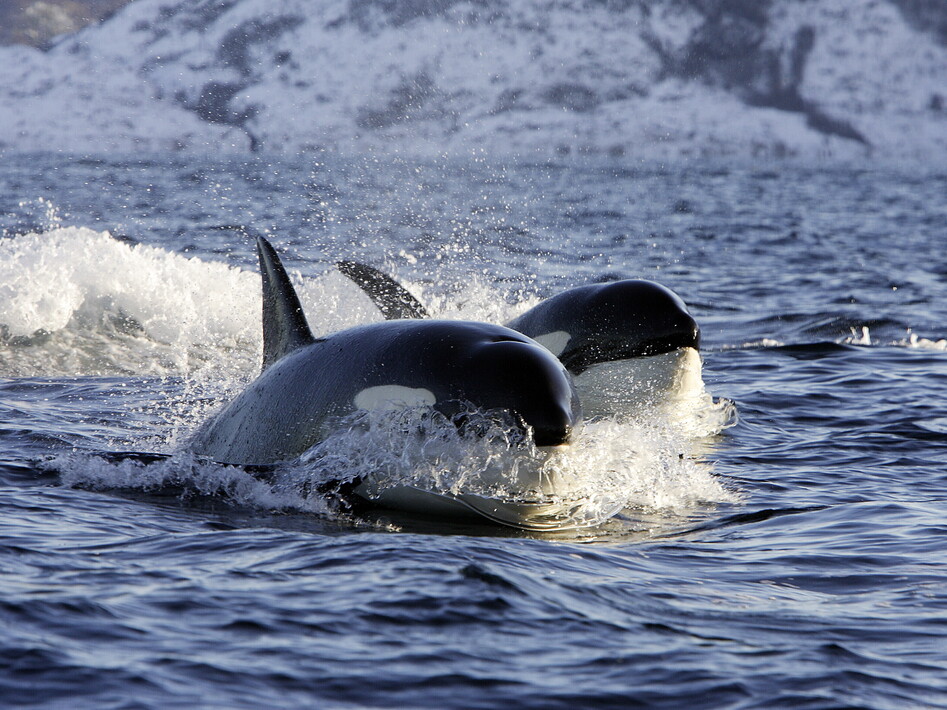
It has long been known that group hunting offers considerable advantages, but the details of how large marine predators organise themselves during hunts have remained largely mysterious. Using drone footage, researchers were able to closely observe the predatory behaviour of these creatures, uncovering sophisticated spatial coordination and a genuine division of labour. The key strategy observed was the underwater “tail slap”, used by orcas to stun herring. Strikingly, tail slaps performed in pairs - joint slaps, involving one orca as the striker and another close by as the helper - were found to be more successful than those performed by a single individual. Pair hunting proved to be the most common strategy, accounting for 74.6% of observations compared to 25.4% for solo hunts. What emerges is a remarkable organisation: at the start of a joint slap, orcas assume precise geometric positions. They often orient belly-to-belly, approaching and rotating their bodies towards one another. This synchrony suggests a high level of cooperation. The research also highlighted a clear division of roles and role specialisation. Individuals tended to maintain their role as striker or helper across multiple hunting events. Interestingly, larger orcas - especially adult males - were predominantly strikers, likely due to their greater efficiency at stunning herring with their more powerful tails. A crucial aspect of this cooperation is partner choice. Orcas do not pair up randomly for hunting; they prefer to collaborate with individuals with whom they share long-term social bonds - ties that can last for decades. These enduring bonds allow repeated opportunities for practice and learning, refining technique and increasing hunting success. It is also thought that these pairs are often kin, with post-hunt food sharing further reinforcing the benefits of cooperation. The division of labour also serves to pass on knowledge and hunting techniques from adults to younger individuals. These findings underline the importance of social organisation, pair bonds and learning in orcas’ cooperative hunting behaviour. A better understanding of these mechanisms could also help develop management measures to minimise the impact of human activities - such as boat traffic - on the hunting behaviour of these fascinating predators.