
Perseverance: on Mars traces consistent with ancient life forms
11 September2025
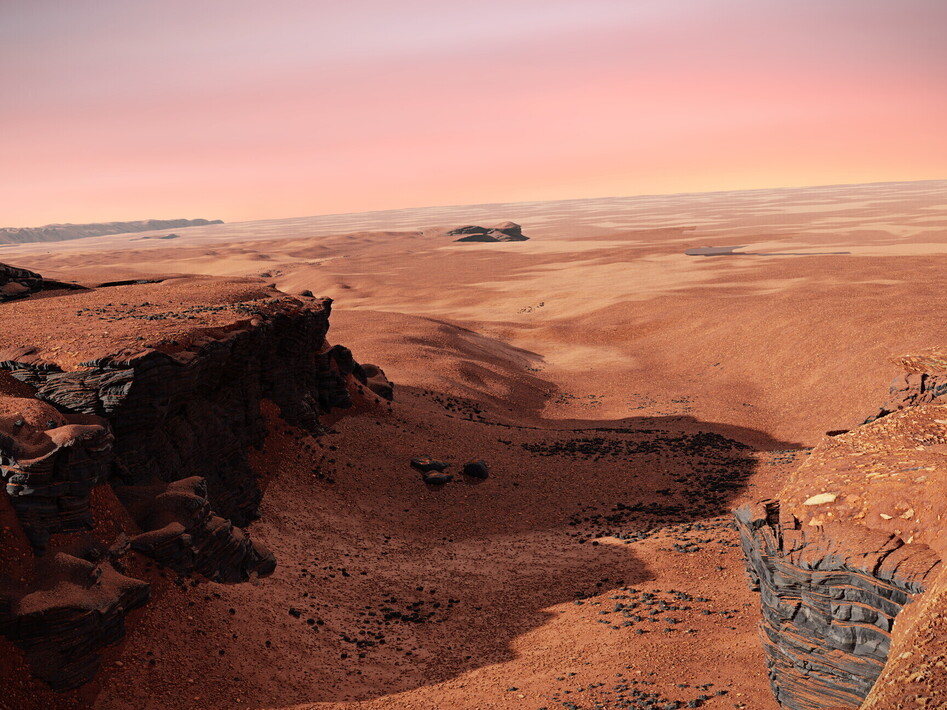

Imagine standing on a distant, arid red planet - its present-day barrenness hiding a vastly different past. This is Mars, which billions of years ago was home to rivers and lakes.
In one of these ancient basins, the Jezero Crater, NASA’s Perseverance rover is on the hunt for signs of past life. And recently, it made a discovery that has thrilled scientists: tiny indicators of chemical interactions between minerals and organic compounds - carbon-based molecules that form the very “building blocks” of life on Earth. Inside the crater, Perseverance has been exploring an area known as Bright Angel, made up of solidified mud layers and pebbles transported by water. While analysing these rocks, the rover discovered small blue-green nodules, no larger than a grain of sand, along with peculiar “leopard spots”: round patches with dark edges and lighter centres. These minuscule details, visible only with highly sophisticated instruments, are far from decorative quirks. They reveal the presence of peculiar minerals such as vivianite (an iron phosphate) and greigite (an iron sulphide). On Earth, these minerals often form in aquatic environments where microbes use iron and sulphur to survive. And this brings us to the question on everyone’s mind: did these minerals form through purely chemical reactions, without any involvement of life, or are they the result of activity by Martian microorganisms from billions of years ago? Scientists don’t yet have the answer. It’s possible that natural processes were sufficient - perhaps involving organic molecules brought in by meteorites. But it’s equally true that, on Earth, similar minerals are often considered direct “fingerprints” of microbial life. These observations don’t prove that life once existed on Mars, but tell us something essential: in Jezero Crater, there was water, reactive minerals, and organic compounds. In other words, the conditions necessary to support life were present. Perseverance has also collected a sample called Sapphire Canyon, which may one day be brought back to Earth. Only then, using our most advanced laboratories, will we be able to determine whether the nodules and spots are simply the result of chemistry, or if they conceal a true biological secret. If one day we discover that those tiny signs on Mars were produced by ancient microbes, it would be revolutionary: it would mean that life is not a phenomenon unique to Earth, but something that can emerge elsewhere in the Universe. For now, we can picture Perseverance as a cosmic detective, sifting grain by grain through an enormous crime scene billions of years old. And with every new clue, we inch closer to answering the most compelling question of all: are we truly alone in space?
Written by the Editorial Team