
The planet of ants
28 October 2025
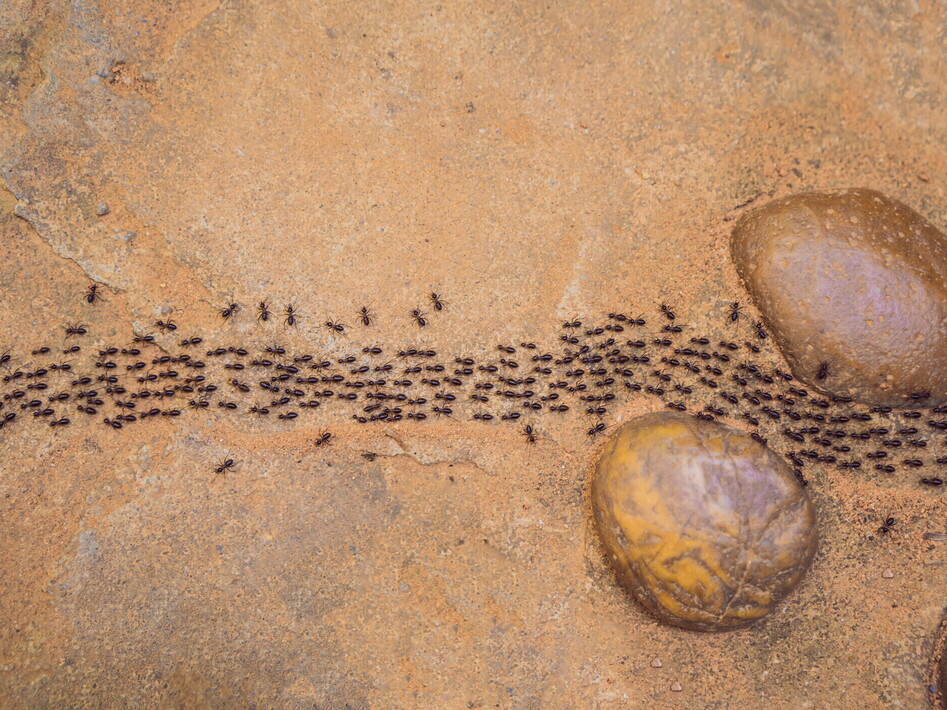

They are everywhere - crawling along pavements, in gardens, and through forests. But how many ants are there on Earth? And what role do they play?
Biologist Edward O. Wilson famously described them as “the little things that run the world”. Despite their crucial importance to our planet’s ecosystems, estimating their exact numbers has always been a challenge. Recently, a study finally provided the most comprehensive estimate yet of this enormous population, based on real data. The research analysed data from no fewer than 489 studies conducted across all continents and in every major type of habitat, focusing on ants living both on the ground and in trees. The results are nothing short of astonishing. Scientists estimate that the number of ants living on the ground alone exceeds 3 quadrillion (that’s a 3 followed by 15 zeroes). Extending this estimate to include all ants worldwide - including those that live in trees and those that never leave the nest to forage (which make up around 78% of a colony) - the total number comes to roughly 20 quadrillion individuals. Just imagine: twenty million billion ants! This gigantic population has an impressive total weight: about 12 million tonnes of dry carbon. To put that into perspective, this amount of biomass (the total mass of living organisms) equals around 20% of the total weight of all humans on Earth, which is estimated at 60 million tonnes of carbon. The authors of the study emphasise that this is still considered a conservative estimate, due to the lack of data for certain key environments - such as boreal forests, subterranean habitats, and specific life stages like larvae or reproductive ants, which were not fully accounted for. Ants are not evenly distributed across the planet. Their abundance is particularly concentrated in tropical and subtropical regions. Remarkably, nearly two-thirds (61%) of all ants living on the surface of the soil are found in just two types of environments: tropical rainforests and tropical savannahs. This highlights how vital these regions are in sustaining the entire global ant population. The highest densities of ants (that is, the number of ants in a given area) are found in forests, especially in the leaf litter - the layer of fallen leaves and debris on the forest floor. On the other hand, ant foraging activity on the ground is higher in dry regions, such as arid scrublands, Mediterranean scrub, and savannahs. This difference is linked to the sampling methods used: pitfall traps, which measure activity, work best in open environments, while leaf litter samples give a more accurate idea of actual population density.
Ants are essential to terrestrial ecosystems due to their complex interactions with other organisms. They play vital roles.
- They disperse seeds for many plant species (a process known as myrmecochory).
- They live in symbiosis with other sap-sucking insects (known as trophobionts).
- They host a wide range of associated organisms (myrmecophiles).
- They act as both predators and prey, maintaining balance within food webs.
It is their sheer numbers and constant activity - rather than just species diversity - that determine the scale of their ecological impact. They are true “ecosystem engineers”, capable of profoundly altering the environments in which they live. They influence nutrient decomposition, soil mixing, and soil movement. Ants can dig up to 13 tonnes of soil per hectare per year, significantly increasing the local availability of nutrients. They create and maintain suitable microhabitats and are fundamental to many different environments. Their ubiquitous presence has led to the development of specialised ecological interactions, even influencing the evolution of other organisms. For example, there are mammals that specialise in eating ants - such as anteaters, pangolins, and the echidna - and in the tropics, there are more species of arthropods that mimic ants (myrmecomorphs) because ants are so abundant. Despite the wide geographical coverage (176 different areas), the study highlights significant gaps in our global knowledge of ants. Many regions - such as Central Africa (an area particularly rich in several ant species) and much of Northern Asia - are poorly represented. More importantly, there is a lack of data for arboreal (tree-dwelling) and subterranean layers, where ants are especially abundant in tropical forest canopies and underground habitats. The study’s findings provide a crucial foundation for exploring which environmental factors influence ant abundance and how ants respond to climate change. To obtain a truly complete picture, it is essential to fill these gaps - by focusing on under-studied regions and habitats and by adopting standardised sampling protocols. As the aforementioned Edward O. Wilson (author of the bestseller Ants) urged, a greater “presence in the field” is needed to deepen our understanding of global biodiversity. Though small, ants have a massive impact on the health of our planet.