
Space
The Universe appears to us as being made up of an innumerable number of bodies, some luminous like the Sun and stars, others opaque like the Moon...

Since ancient times, humans have observed the sky and sought to understand what the objects they saw were and how they moved. Observations might have suggested that the Earth was stationary at the centre of the Universe; today we know that our planet is a tiny dot like the others, moving in an immense space containing countless celestial bodies of various sizes, origins and natures. From observing the sky we can understand how celestial objects are made and how the space in which they move, and in which our planet also moves, is structured.
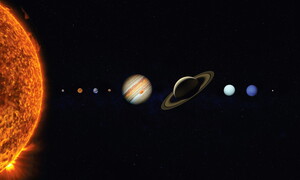
Today we are at a very privileged time in the exploration of our planetary system. The big space missions of the present and of the past have enabled us to start knowing the profile and the characteristics. So we can have a new image of this part of the Universe, in which the Sun and the planets are not the only protagonists, and we find satellites, like the Moon, the asteroids, the comets, the dusts. And not only that, like a glue that does not allow the parts that are deep in space to disperse, there is the force of gravity and we make the effort to imagine a system of bodies of a different nature and size rotating around a medium sized star. We are now ready to start entering more deeply into this space.