


The mystery of Ithaca: did Odysseus’s island really exist?
11 August 2026
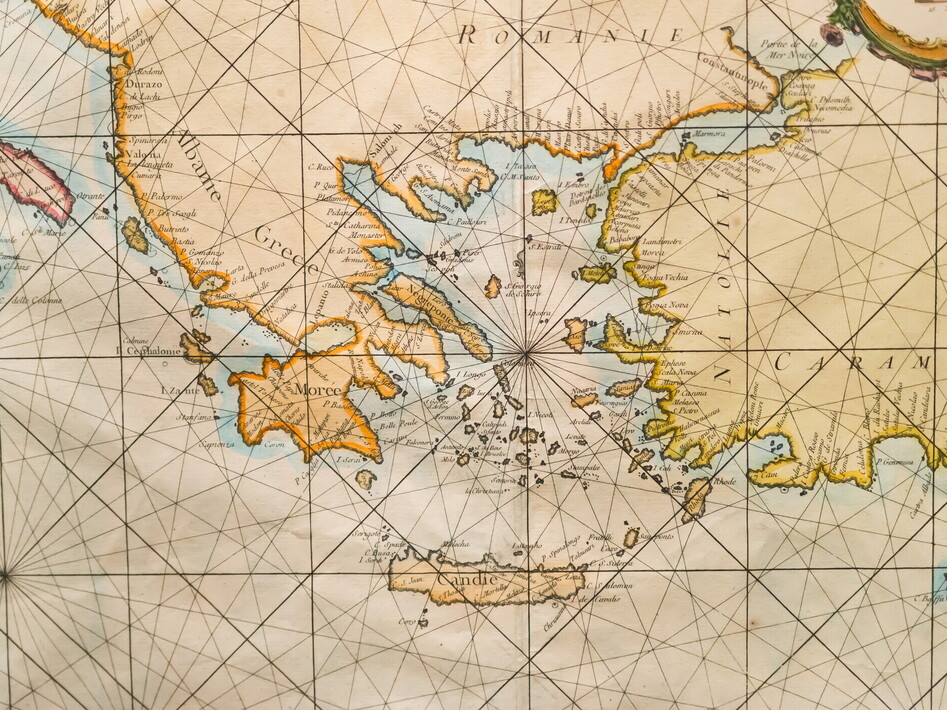

Everyone knows Odysseus, the Greek hero who, in the Odyssey, spends ten long years trying to return home after the Trojan War. His homeland is Ithaca. Yet a question that appears straightforward conceals a genuine archaeological mystery: is the Greek island known today as Ithaca really the Ithaca described by Homer?
For more than twenty years, a team of scholars - including a philologist specialising in Ancient Greek and a geologist - has been seeking an answer by comparing the verses of the Odyssey with the rocks, sediments and underlying geology of the Greek islands. It all begins with a description Odysseus himself gives of his island while speaking to a foreign king who is hosting him. Odysseus says that Ithaca lies close to three other islands, Dulichium, Same and Zakynthos, and adds two precise details: his island is the westernmost of them all and is flat, meaning low-lying and without large mountains. The problem is that the island we now call Ithaca does not match this description at all: it is mountainous, with cliffs plunging steeply into the sea, and lies to the east, not the west, of the neighbouring islands. Something does not quite add up. An English researcher, Robert Bittlestone, had a fascinating insight: perhaps Homer’s Ithaca is not the island that bears that name today, but Paliki, a peninsula forming part of the island of Kefalonia. Paliki is indeed low-lying - just as Homer says - and is the westernmost part of the entire archipelago. There was one obstacle, however: today Paliki is not a separate island but is joined to Kefalonia by a strip of land a few kilometres wide, the Thinia valley. To make his theory work, Bittlestone proposed that, in Homer’s time - around 1200 BC - this strip of land had actually been a navigable sea channel, which was later gradually filled by landslides and debris generated by the region’s frequent earthquakes. If so, Paliki would indeed have been a separate island, just like the Ithaca described by Homer. Fascinating though the idea was, however, it was not enough simply to propose it: any serious hypothesis had to be tested against the evidence. This is where geology comes into play. For twenty years, a team of geologists studied the Thinia valley using every tool available: detailed geological maps, aerial laser surveys, seismic waves and even thirteen boreholes drilled into the ground to extract rock cores for laboratory analysis. After all this work, the result was surprising: the sea had indeed occupied that valley, but thousands upon thousands of years before Homer, between 400,000 and 290,000 years ago. At the time of the Trojan War, therefore, there was no navigable sea channel: Bittlestone’s original hypothesis, as he had conceived it, does not stand up.
At this point the story seemed to be over, but the philologist James Diggle had a surprising, almost detective-like idea: what if the problem lay not in the geology, but in our interpretation of Homer’s verses? Rereading the entire text of the Odyssey carefully, Diggle noticed something that no one had ever observed with such clarity: nowhere in the poem does Homer call Ithaca ‘an island’. He always calls it ‘land’, ‘homeland’ or ‘region’. When he speaks of the neighbouring islands - Dulichium, Same and Zakynthos - however, he always uses the Greek word for ‘island’. Never for Ithaca. Diggle also identified two other subtle linguistic clues: for the islands, Homer uses an adjective meaning ‘surrounded by water on all sides’, whereas for Ithaca he uses another that means, rather, ‘washed by the sea on only two sides’. An insignificant detail? Perhaps not: it would perfectly describe a peninsula, surrounded by sea on three sides but connected to the mainland, exactly as Paliki is today. Bringing all the clues together, Diggle proposes the following explanation: in Homer’s time there was one large island made up of two connected parts, the western peninsula, called Ithaca and home to Odysseus, and the eastern part, called Same. Together, the two parts formed the island that the Greeks would later call Kefalonia. Only centuries later, when no one could remember exactly where Odysseus’s true Ithaca had been, did the Greeks decide to bestow this glorious name on another nearby island, the one we still call Ithaca today. This story demonstrates something valuable: solving a mystery almost three thousand years old requires very different disciplines to work together - philology, which studies every single word of an ancient text with precision, and geology, which literally digs into the ground to find concrete evidence. Neither, on its own, would have solved the puzzle. The story offers another valuable lesson: when a theory appears to be wrong, the answer is not always to discard it altogether, but to reconsider the problem from a different angle. That is precisely what Diggle did, returning with fresh eyes to a text that everyone believed they already knew by heart.