


Alien life in caves
30 March 2026
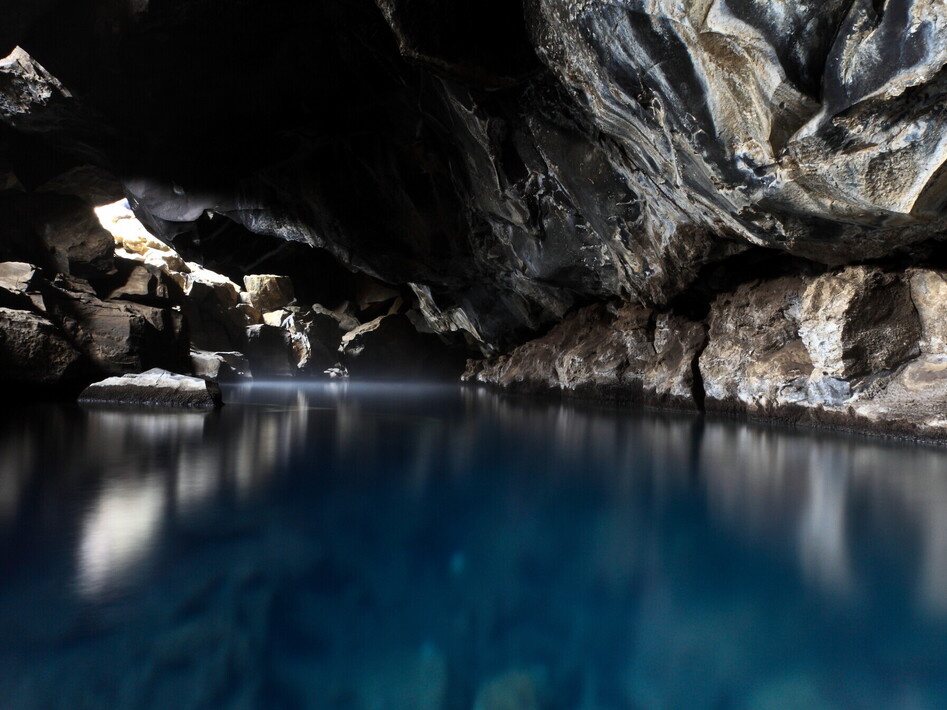

When we think about the search for extraterrestrial life, we often imagine giant telescopes pointed at distant stars or rovers digging through Martian dust. But another surprising frontier in understanding how life might exist on other worlds lies beneath our feet.
Deep caves on Earth are transforming the way scientists look for clues to life beyond our planet and are opening up new perspectives in astrobiology. Many worlds in our Solar System, such as Mars or Europa, Jupiter’s icy moon, may have underground environments shielded from radiation; in this sense, caves offer natural refuges where milder conditions could allow life to survive or leave persistent traces. On Mars, for example, scientists have identified potential tunnels and underground cavities that may once have preserved water or could even host microbial life today. The presence of water is fundamental, because on Earth every known form of life depends on it. Scientists use terrestrial cavities as analogues to better understand what we might find elsewhere. Beneath our planet’s surface there are extreme environments, with low temperatures, no light and limited resources, similar to those that may exist under the crust of other celestial bodies. Studying how terrestrial organisms adapt to these conditions gives us a kind of “survival map” for possible life forms elsewhere. A fascinating example comes from the so-called fluorescent caves in South Dakota, where minerals in the rocks glow with vivid colours under ultraviolet light. Scientists have discovered that these minerals, deposited millions of years ago by the action of water, indicate that the underground environment has chemical characteristics that could support life. Studying these rocks and the microbes that inhabit them helps astrobiologists understand which chemical fingerprints to look for on other planets. Research in deep caves is not limited to finding organisms that survive in total darkness. It also helps us understand which chemical or biological signs might remain if life once existed on Mars or beneath Europa’s ice. Certain minerals or molecules, for instance, reveal biosignatures - clues or signatures that point to biological processes. Moreover, exploring Earth’s caves teaches us far more than might seem obvious: environments completely cut off from sunlight and rich in chemicals from deep within the planet can host microbes that feed on chemical energy rather than light. This type of metabolism, known as chemosynthesis, is considered a possible model for life on worlds with subsurface oceans, such as Europa or Enceladus, another moon of Saturn. Looking at Earth’s caves as examples of extreme environments helps us redefine where and how to search for extraterrestrial life. Instead of focusing only on planetary surfaces, we are increasingly considering what may lie beneath them: protected spaces, rich in water and potentially able to sustain life even under harsh conditions. In short, Earth’s caves are not just fascinating places for speleologists and geologists: they are natural laboratories for astrobiology, teaching us how life - even in microbial form - might survive beyond our planet. The next time we think about the search for “aliens,” it may not be enough to look up at the sky: we may also have to dig below the surface.