


Which came first: the egg or the mammal?
11 May 2026
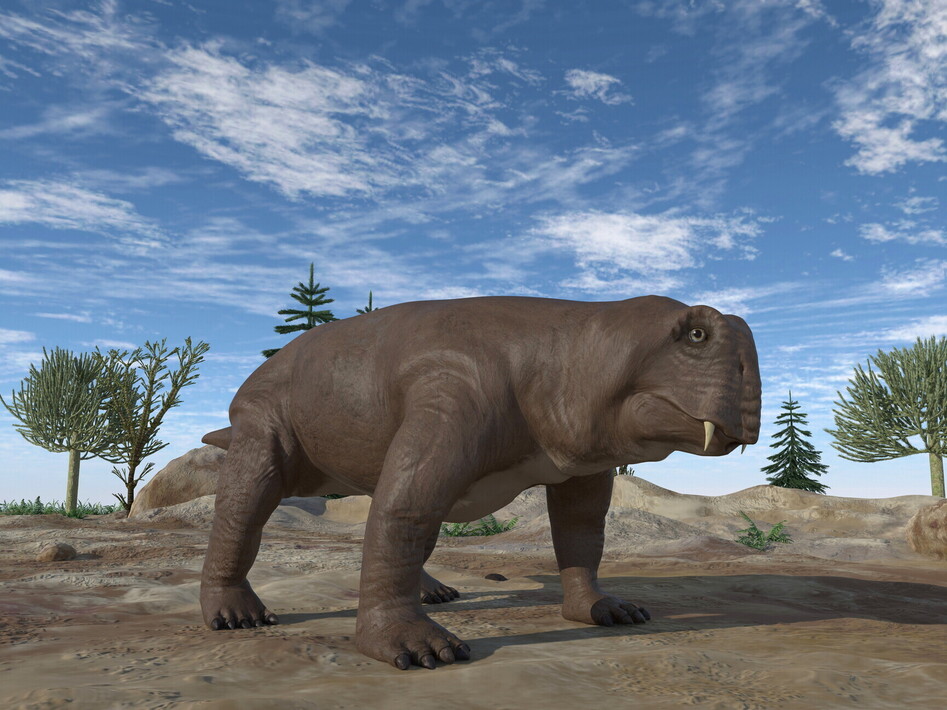

For a long time, scientists wondered how the earliest ancestors of mammals reproduced. Today, most mammals give birth to well-developed young. But was that also the case millions of years ago?
A new scientific discovery appears to have solved this mystery, thanks to an extraordinary fossil dating back around 250 million years. The fossil contains the embryo of an animal called Lystrosaurus, a distant relative of modern mammals. This embryo was found inside a fossilised egg and represents the first direct evidence that the ancestors of mammals laid eggs, just as reptiles and birds do today. Lystrosaurus was a herbivore belonging to the therapsids, a group of vertebrates from which mammals later evolved. It lived between the end of the Permian and the beginning of the Triassic, around 250 million years ago. At that time, the Earth was undergoing a major mass extinction: at the end of the Permian, huge numbers of animal and plant species disappeared. Despite this catastrophe, Lystrosaurus managed to survive and spread across many parts of the planet, becoming one of the most common animals of its time. Scientists believe that some of its biological features may have helped it adapt to an extremely challenging environment, marked by intense heat and long periods of drought. The fossil studied by researchers is truly exceptional: inside it is a tiny curled-up embryo, preserved within the egg for millions of years. Using advanced technologies, including scans performed with powerful diagnostic instruments, scientists were able to observe the embryo without damaging the fossil. The analyses showed that the animal was not yet fully developed: some parts of its skeleton, such as the jaw, had not completely formed. This suggests that the young animal would have hatched from the egg before becoming independent. Why had such a discovery not been made before? Probably because the eggs of these ancient animals did not have a hard shell like birds’ eggs. They were more similar to those of platypuses and echidnas, the only modern mammals that still lay eggs. These eggs had a soft, flexible shell, which is extremely difficult to preserve in the fossil record. For this reason, finding a fossilised embryo of this kind is an exceptionally rare event. The discovery helps scientists better understand how mammals evolved over the course of Earth’s history. The earliest mammal ancestors probably laid eggs, and only much later did some species begin to “retain” them inside the body and give birth to already developed young. Studying fossils such as this one allows researchers to reconstruct the history of life on our planet and to understand more clearly how animals adapted to environmental changes over millions of years. That small, fossilised egg contains not only an ancient embryo, but also a piece of evolutionary history that would ultimately lead to the appearance of modern mammals… and of our own species.