


The Nazca Lines: a great mystery we may finally be close to solving
18 March 2026
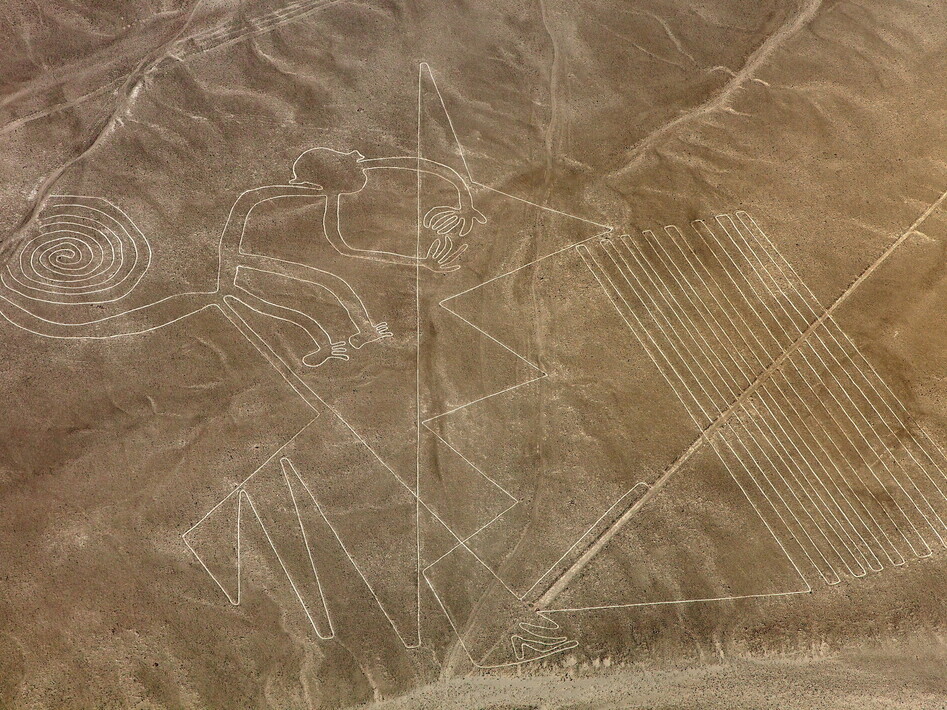

In the desert of Peru lies one of archaeology’s greatest enigmas: the Nazca Lines. These are gigantic drawings traced on the ground more than two thousand years ago. For over a century, scholars have tried to understand who created them and why.
Today, thanks to new technologies and artificial intelligence, scientists believe they may be getting closer to solving this ancient puzzle. The Nazca Lines are known as geoglyphs, meaning drawings made directly on the Earth’s surface. They are located in a vast desert area south of Lima, the capital of Peru. These drawings depict many different figures: animals such as birds and monkeys, geometric shapes such as spirals and trapezoids, as well as images of plants and people. Altogether, the figures cover an area of around 450 square kilometres — an immense space, almost the size of a large city. The most astonishing thing is that many of these drawings are so large that they can be properly seen only from above, for example from an aeroplane or a drone. The authors of these works were the ancient Nazca, a civilisation that lived between about 200 BC and AD 650. The lines were not painted. The Nazca created them by moving away the dark stones covering the desert surface, revealing the lighter ground beneath. This method has allowed the drawings to remain visible for centuries. The desert climate is extremely dry and receives almost no rainfall; as a result, the lines have not been erased by time. Scholars believe that the Nazca carefully planned the figures using simple tools and precise measurements. The true meaning of the lines remained a mystery for a long time. Over the years, many hypotheses have been proposed. Archaeologists suggested that they might be an astronomical calendar linked to the stars, ritual pathways used during religious ceremonies, or markers indicating the presence of water in the desert. None of these theories, however, has ever been fully proven. In recent years, archaeologists have begun using satellites, drones and aerial images to study the desert. But the area is enormous, and analysing all the photographs takes a very long time. For this reason, some researchers decided to use artificial intelligence: algorithms were trained to recognise the drawings in images of the ground. The result was remarkable: in just six months, scientists discovered 303 new geoglyphs, almost doubling the number of figures previously known. Thanks to these discoveries, researchers began to think that many of the figures were meant to be seen by people walking along particular paths in the desert. This suggests that the lines may have been created to accompany processions or religious rituals, displaying images linked to the activities and beliefs of the Nazca people. The use of artificial intelligence is changing the way archaeologists study the past: algorithms can analyse vast quantities of data far more quickly than human beings. Naturally, the discoveries must still be verified by archaeologists in the field, but technology helps identify new sites to investigate far more efficiently. Although we have learnt a great deal about the Nazca Lines, their meaning is still not completely clear. Yet thanks to new technologies, scientists are uncovering more and more details. Perhaps in the coming years we will finally understand why the ancient Nazca created these enormous drawings in the desert. A mystery that has lasted for more than two thousand years may at last be solved.