


In six years, an asteroid could hit the moon
19 February 2026
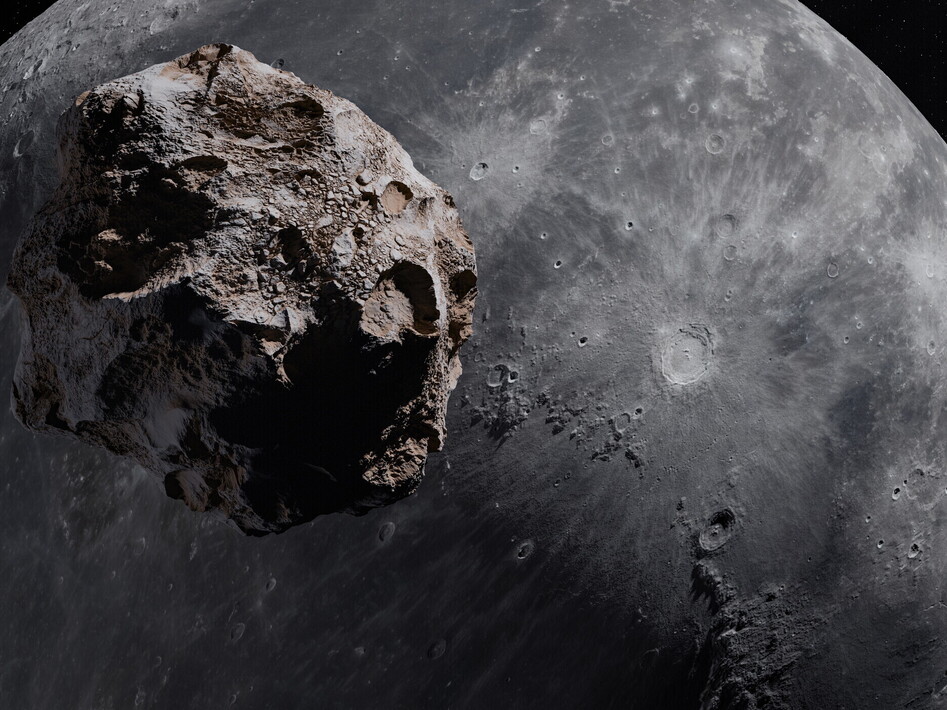

A new scientific study has drawn the attention of astronomers and skywatchers alike: asteroid 2024 YR4, a rocky body about 60 metres in diameter, still has a small chance of striking the Moon on 22 December 2032.
The object was discovered at the end of 2024 and has been closely tracked by telescopes and missions, including the James Webb Space Telescope. After ruling out an impact with Earth - scientists insist that our planet faces no danger from this asteroid - attention has shifted to the possibility that it could head towards our natural satellite. If the asteroid were indeed to collide with the Moon, the impact would release an enormous amount of energy - equivalent to millions of tonnes of TNT - and could create a crater up to one kilometre wide. According to the authors of the study, the impact could produce a bright flash on the lunar surface intense enough to be visible from Earth, with a brightness comparable to that of Venus or, in some simulations, even the full Moon. This flash would last several minutes, but would be clearly observable for at least around ten seconds under favourable conditions. Whether it could be seen with the naked eye depends on where the asteroid would strike the Moon: if the impact occurred on the unlit side, the chances of seeing it without instruments would increase significantly. However, this circumstance is estimated to have only a low probability, since about 70% of the Moon will be illuminated on that day. Beyond the initial flash, the impact could eject millions of kilograms of lunar material into space. Some of this debris could then reach Earth as a shower of lunar meteors, creating a phenomenon similar to a meteor shower but made up of fragments of lunar rock. Scientists consider this event a unique opportunity to study a major impact on a nearby celestial body in real time. Coordinated observations using ground-based and space-based telescopes could provide valuable data on impact dynamics and crater formation. The probability of impact remains low - only a few percentage points - and the event is by no means certain. However, each new observation of 2024 YR4’s orbit over the coming years - especially in 2028, when it will become visible again - will help clarify the real likelihood. In short, while the Earth is now safe from this asteroid, the Moon may offer us a fascinating celestial spectacle in about six years’ time - a visible flash in the sky and perhaps a meteor shower unlike any seen before.