


A giant eye on the Universe: the Roman space telescope launches
2 September 2026
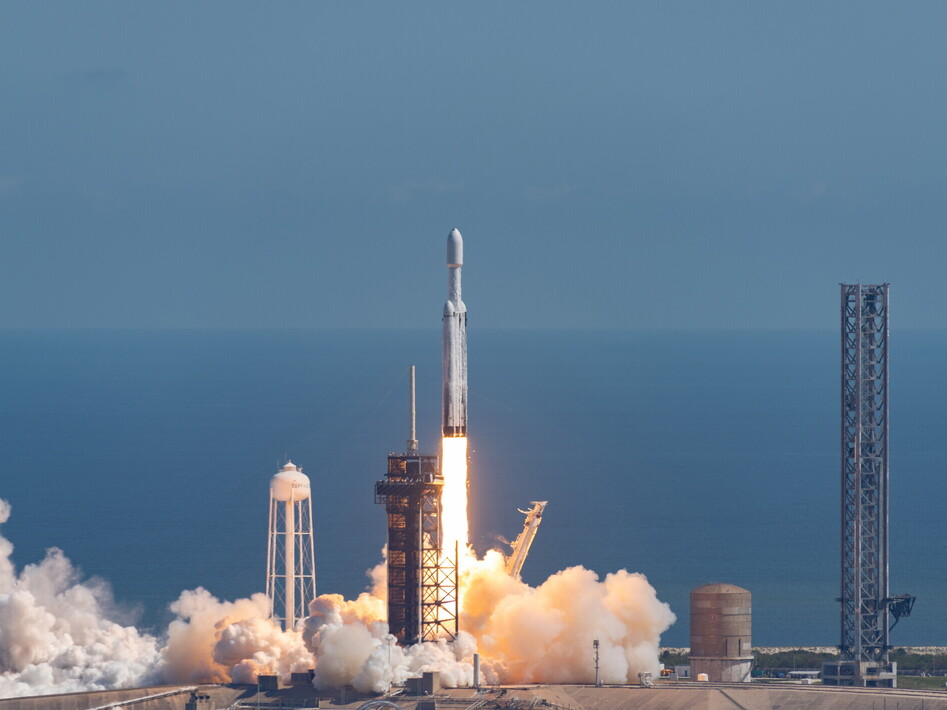

On 30 August 2026, at 7:26 a.m. US Eastern Time, a SpaceX Falcon Heavy rocket lifted off from the Kennedy Space Center in Florida.
On board was NASA's new space telescope, the Nancy Grace Roman Space Telescope, named after NASA's first chief of astronomy, also known as the "mother" of the famous Hubble Space Telescope. Unlike many satellites, Roman will not remain close to Earth. Its destination is a special location in space known as L2 (the second Lagrange point), approximately 1.5 million kilometres away from Earth, on the opposite side from the Sun. At this point, the gravitational forces of the Earth and the Sun balance out, allowing the telescope to maintain its position relative to Earth without using too much fuel for course corrections. The journey will take around three months. The launch went extremely well: just seven minutes after lift-off, engineers on the ground received the first signals from the telescope, and around an hour and a half later, its solar panels, which will power all the instruments on board, successfully deployed. Roman's most remarkable feature is its field of view: it can observe an area of sky at least 100 times larger than Hubble can, while maintaining exceptionally sharp image quality. It is a little like switching from a photograph taken with a powerful zoom lens offering a narrow field of view to an equally detailed but much wider panoramic image. At the heart of the telescope is a 300-megapixel infrared camera, which will be switched on a few weeks into the journey. Thanks to this "super-camera", Roman will be able to observe light from around a billion galaxies over the course of its mission. Scientists hope the telescope will help them unravel some of the greatest mysteries in astrophysics: how the Universe has evolved over billions of years, from its origins to the present day; what its ultimate fate will be, or how it will continue to change in the future; and whether other Earth-like planets exist, perhaps even capable of supporting life.
To achieve this, the telescope will also study two mysterious phenomena known as dark matter and dark energy: invisible forms of matter and energy that we cannot observe directly, but whose effects we can detect through their influence on the movement of galaxies and the expansion of the Universe. Once operational, Roman will generate approximately 1.4 terabytes of data every day, more than any previous NASA astrophysics mission. To analyse this enormous volume of information, scientists will use artificial intelligence tools, as well as the help of volunteer citizen scientists from around the world, who will be able to contribute to the discovery of new galaxies, stars and planets. A three-month phase of testing and checking all the instruments is now beginning. If everything goes according to plan, Roman's first publicly released images will arrive in the early months of 2027: a new way of looking at the Universe that could forever change our understanding of the cosmos.
(Source: Sci.News, 30 August 2026)