

Why leaves change colour in autumn
13 November 2025
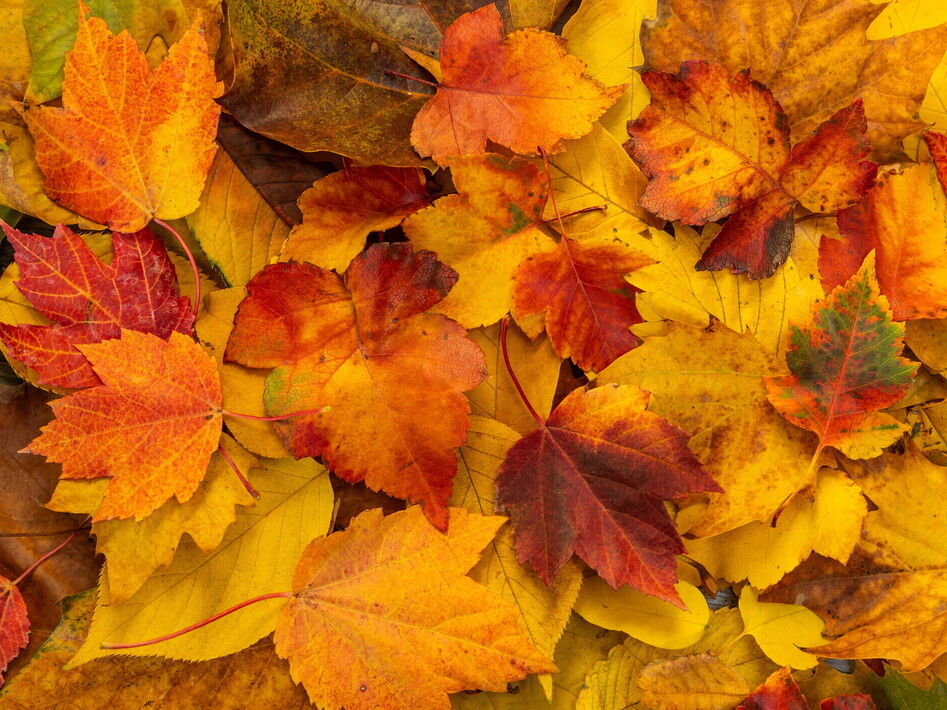

When autumn arrives and the days grow shorter, many deciduous plants (those that lose their leaves) such as broad-leaved trees enter a special phase.
Leaves that were green in summer begin to change colour: from green they turn yellow, orange, red or even purple. This display is clearly visible in woods and parks, and it is a sign that something important is happening inside the plants. The green colour of leaves during the warmer months is due to a substance called chlorophyll. Chlorophyll is essential because it allows the plant to carry out photosynthesis: it transforms water and carbon dioxide into sugars using sunlight, providing nourishment for the tree. When autumn comes, however, the plant “decides” to halt this process, because the conditions (less light, lower temperatures) make photosynthesis less efficient. At the same time, the tree begins to recover valuable materials from the leaf before it falls. As chlorophyll levels drop, colours that were previously hidden become visible. Yellow and orange pigments – coloured substances called carotenoids – were already present in the leaves, but masked by the green of the chlorophyll. When chlorophyll disappears, these pigments emerge and the leaf takes on a yellow or orange hue. In some plants, new red or purple pigments called anthocyanins are produced in autumn. These were not present during the growing season, but form when the leaf is in a phase of “senescence” (ageing), under particular light and temperature conditions. An interesting aspect is that the most intense colours appear when autumn days are sunny and the nights are fairly cool (but not freezing). Under these conditions, anthocyanin production is favoured: the leaf accumulates residual sugars while the vessels that transport fluids are gradually closing, and this combination encourages the red-violet colour. By contrast, if nights are too warm or days too overcast, the colours tend to be more subdued.
Why does the plant do all this? Partly for reasons of economy: the leaf is not simply “cut off”, but the tree tries to reabsorb valuable nutrients (such as nitrogen) before it drops. The pigments and the gradual closure of the vessels in the leaf help this process. According to some theories, anthocyanins also protect the leaf from light damage during its final phase on the branch, allowing the plant to recover as much as possible before it detaches. When at last the leaf has done its job, it is no longer useful and falls from the tree. By then, the green colour has almost completely vanished, the hidden pigments have played their part, and nature is preparing for winter. For us, this is a beautiful spectacle: red, orange and yellow carpets covering woods and parks, perfect for autumn walks and for pausing to reflect on the beauty of nature. But the changing colour of leaves is not just a spectacular phenomenon: it is the result of a highly precise biological process. The plant is preparing for the cold season, closing its “accounts” with the warmer months, recovering valuable materials and then letting the leaves go. And we can look at nature with different eyes: not only at the wonderful colours, but also at a message of change, adaptation and the cycle of life.