


The far side of the Moon
8 April 2026
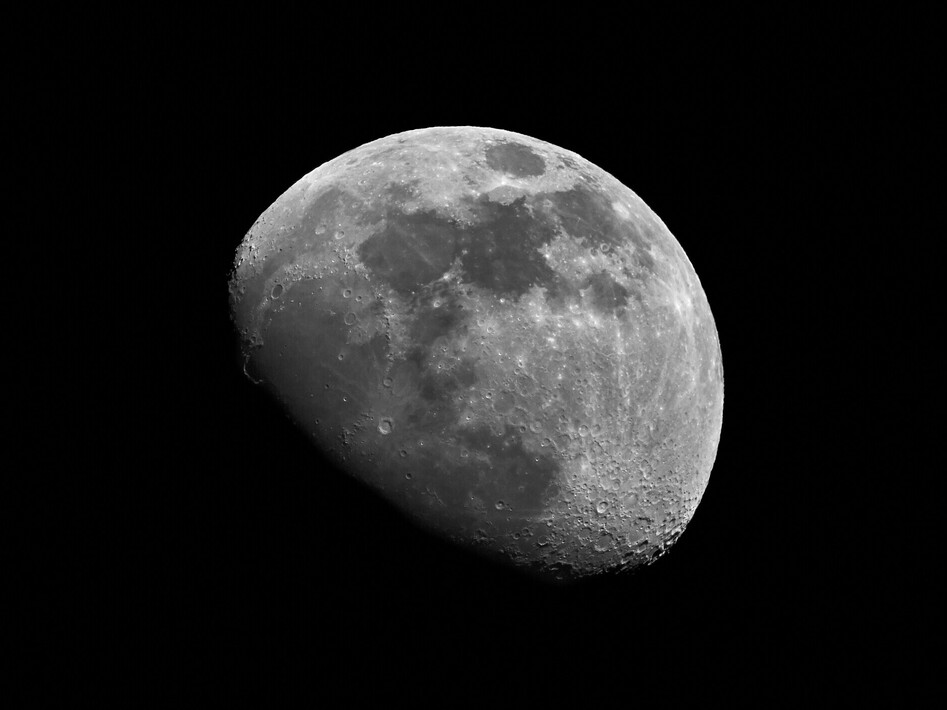

The Moon always shows the same face to the Earth. The reason is simple: it rotates on its axis in exactly the same time it takes to orbit our planet. Even though we cannot see it, we might assume the hidden side is similar to the one we know… but it is not, and we may now finally understand why. First, let’s clear up a common misconception. The side of the Moon we do not see is not dark, as Pink Floyd famously suggested - it is illuminated by the Sun just as much as the side facing us.
When the band created their iconic 1973 album The Dark Side of the Moon, they were referring instead to those aspects of the human psyche that elude rational control - the “dark side” within each of us. In other words, it is a metaphor: the unseen side is “dark” only because it is unknown. In reality, thanks to China’s Chang’e-6 mission, we now have two kilograms of material collected by robotic explorers from the Moon’s far side. An extraordinary achievement: after 53 days of work, the capsule returned from the Moon and, on 25 June 2024, parachuted down in Mongolia, bringing back for the first time invaluable rock samples that may help solve a mystery that remains - this time literally - in the dark. Why is the side of the Moon we see so different from the one we do not? First of all: in what way are they different? We are all familiar with the Moon’s appearance. How often have we searched for the Sea of Tranquillity or the Sea of Serenity during a full Moon - perhaps in a romantic or melancholic moment. In any case, it is a deeply evocative sight. About 16% of the Moon’s surface is covered by so-called “maria” (seas), which, unlike those on Earth, contain no water. They are vast plains of basalt, a dark volcanic rock formed billions of years ago from eruptions of molten lava triggered by massive asteroid impacts that heated the surface of our battered satellite. The Moon’s brighter regions are covered in regolith, a type of rocky material that reflects sunlight and therefore appears lighter. These areas are also higher in elevation than the maria, forming plateaus and hills. As early as 1959 - when the Soviet probe Luna 3 sent back the first images of the far side - we learned that, on the other side of the Moon, there are no maria, as the Italian singer Lucio Dalla once poetically noted. Instead, there are mountains and craters, and the surface appears almost uniformly light grey. Moreover, gravitational data indicate that the lunar crust on the far side is thicker than that on the near side - by about 20 kilometres on average. This difference in crustal thickness is another key feature distinguishing the Moon’s two hemispheres. Why, then, does the Moon have two such different faces? To answer this, we must go back to its origin. According to the widely accepted giant impact hypothesis, the Moon formed when a Mars-sized body collided with Earth at an angle: a violent encounter between young, still-molten planets - like a glancing blow between incandescent billiard balls. The object, named Theia by astronomers, struck Earth around 4.6 billion years ago. The impact tore away a vast mass of debris and molten rock, which eventually coalesced to form the Moon. Newborn and violently ejected, the Moon was much closer to Earth than it is today—about one-tenth of its current distance. This means that only around 30,000 kilometres separated the two bodies. Imagine how enormous the Moon must have appeared in the sky: a full Moon occupying a large portion of the celestial dome. From the very beginning, the Moon began to synchronise its rotation with its orbit, always presenting the same face to Earth. This peculiar relationship may hold the key to explaining the differences between its two sides. The Moon exerts tidal forces on Earth - and Earth does the same to the Moon. Today, these forces move the oceans, but back then, when the two bodies were much closer, they likely acted on rocks that had not yet fully solidified. In those early conditions, Earth’s gravitational pull may have permanently altered the two faces of the Moon. Another hypothesis suggests that the impact created two moons, and that one later collided with the other on the side hidden from us. However, neither explanation is entirely satisfactory. Thanks to the samples returned by China, this ancient mystery may finally be resolved. The key may lie in a long “simmering.” The impact with Theia vaporised part of Earth’s still-hot crust, while the rest became molten lava. For a very long time, Earth’s surface remained covered in rock at temperatures of around 2,000 degrees Celsius. As if on a cosmic spit, the side of the Moon facing our nearby planet was slowly “roasted,” while the far side, turned toward deep space, cooled more quickly. The near side would thus have developed a thinner crust and more intense volcanic activity, while the far side remained relatively cooler, forming a thicker crust. As scientists analyse these new samples to better understand the Moon’s history, humanity has also begun returning to it.
More than fifty years after the Apollo missions, a new generation of astronauts is once again heading towards our satellite under NASA’s Artemis programme. Artemis II, launched in 2026, is the first crewed flight of this new lunar initiative. Four astronauts aboard the Orion capsule are carrying out a wide orbit around the Moon before returning to Earth. They will not land: this is a test mission, a full-scale rehearsal to verify spacecraft systems, deep-space navigation, and crew endurance. The next step, however, will be far more ambitious. Future Artemis missions will see astronauts walking on the lunar surface once again, this time targeting the Moon’s South Pole - a region that may contain water ice and essential resources for establishing permanent bases. The historic achievement of China’s mission, together with the return of American astronauts, marks something new: the beginning of a second great era of lunar exploration. And as robots and humans once again study our satellite up close, it may well be that, among the grey mountains of the unseen side, lies the key to understanding not only the Moon’s history, but also that of Earth itself.