


Shooting star guide: how to see the Delta Aquariids and Perseids
27 July 2026
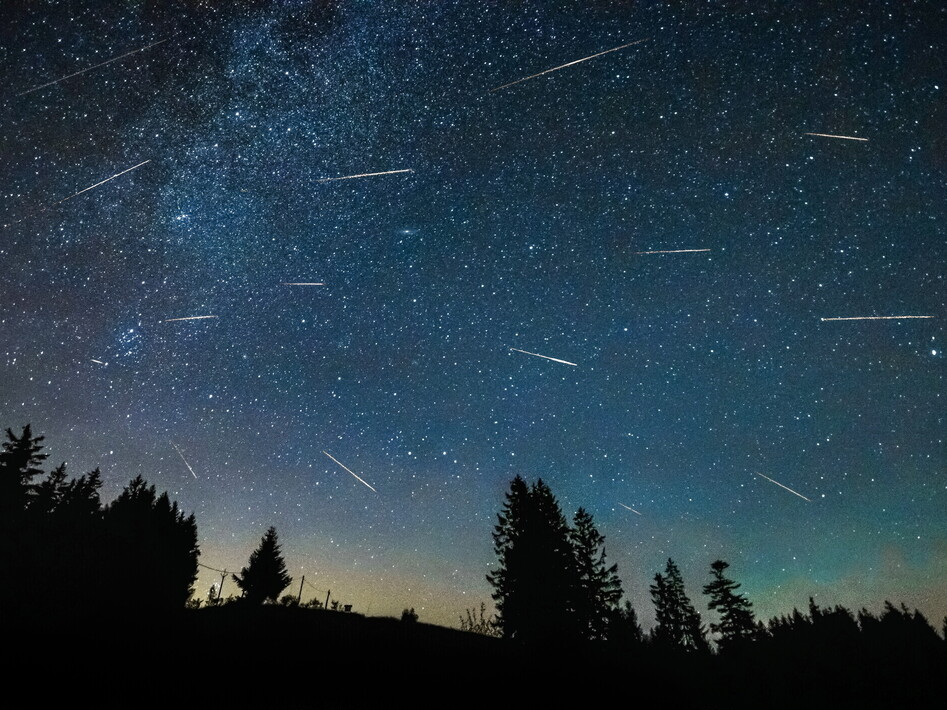

There is a moment every summer when it is worth lying down on a lawn or a beach lounger and looking up at the sky. Between late July and mid-August, the night sky puts on one of its most generous displays: two meteor showers which, one after the other, turn holiday nights into a perfect opportunity to admire shooting stars. Here is what you need to know to make sure you do not miss them.
On the night of 30-31 July 2026, two meteor showers reach peak activity at the same time: the Southern Delta Aquariids and the Alpha Capricornids. It is not often that two meteor showers coincide so precisely, and the combination promises a sky enlivened by medium-speed meteors together with some occasional slow, exceptionally bright fireball. The Delta Aquariids are less showy than some other showers, but extremely reliable: they remain active for weeks, from mid-July to late August, maintaining a steady rate of meteors rather than concentrating everything into a single night. Their radiant - the point in the sky from which they appear to originate - lies in the constellation of Aquarius, near the faint star Skat. To locate it, it may help to use the bright star Fomalhaut or the Great Square of Pegasus as a reference point. Observers in the Southern Hemisphere and the tropics have the best view, but southern Italy and southern Europe more generally can also enjoy a good number of meteors. The Alpha Capricornids, by contrast, are a minor shower in terms of quantity, producing only a few meteors per hour, but they make up for this in quality: they generate slow, brilliant fireballs capable of making an impression even on those who watch for only a few minutes. Their radiant lies in the constellation of Capricornus and can be found by tracing a line from Altair in Aquila. There is one complication this year, however: the peak comes immediately after the full Moon, which will remain high and bright for much of the night, washing out the fainter meteors. A good compromise is to try observing about a week before the peak, when the Moon sets around midnight and leaves darker skies, or, during the peak itself, to find a viewing spot where a tree, hill or building blocks the lunar disc.
One curious detail is that, on the same nights, the first tentative Perseid meteors may already begin to appear. They can be distinguished from the Delta Aquariids by the direction they come from. The Aquariids arrive from the south, while the Perseids come from the north-east: when observing after midnight, with a little luck, it is possible to spot meteors from both showers on the same evening. If the If the Delta Aquariids are the starter, the Perseids are undoubtedly the main course of the summer meteor season. Widely regarded as the best-known and most prolific meteor shower of the year, they are active from 17 July to 24 August, but reach their spectacular climax on the night of 12-13 August 2026. The broad maximum will extend from the evening of the 12th into the morning of the 13th, with peak activity expected in the early hours of 13 August. This year, viewing conditions are set to be exceptional: the new Moon falls on 12 August, creating a dark, interference-free sky in which even the faintest meteors, normally washed out by moonlight, should be clearly visible. Under favourable conditions, observers may see up to one hundred meteors per hour, radiating from the constellation of Perseus and often accompanied by exceptionally bright fireballs. The finest viewing comes in the second half of the night, as the radiant climbs higher above the horizon - ideally from midnight until the first light of dawn. The Perseids are readily visible from the mid-latitudes of the Northern Hemisphere, placing Italy in an excellent position for observation. Viewers in the Southern Hemisphere are less fortunate, as the shower is much harder to see from there. The Perseids originate from material shed by comet 109P/Swift–Tuttle, which passes close to Earth once every 133 years but leaves behind a trail of debris that our planet crosses reliably each summer. One historical curiosity is that the shower’s peak falls almost exactly on the feast day of St Lawrence, a third-century Christian martyr. This is why, in many folk traditions, the August meteors are known as the ‘tears of St Lawrence’. Whether it is the double display at the end of July or the eagerly anticipated spectacle of mid-August, watching shooting stars remains one of the simplest and most rewarding free experiences that summer has to offer. No telescopes, binoculars or specialist knowledge are required: all you need is a reasonably dark sky, a little patience and the willingness to look up. For anyone on holiday, perhaps far from the light pollution of towns and cities, this can be the perfect opportunity to turn an ordinary evening into a small shared ritual: a blanket spread on the ground, eyes slowly adjusting to the darkness, and the ever-so-slightly magical wait for the next streak of light to sweep across the sky.
- Practical tips for making the most of this double meteor shower.
- Find a dark location away from city lights, with a clear, unobstructed view of the horizon.
- From Italy, it is best to look south, where the radiants remain relatively low in the sky; in the Southern Hemisphere, the two constellations rise much higher, almost reaching the zenith.
- Bring a reclining chair or a mat, and keep your head slightly raised so that you can remain comfortable and alert.
- Avoid direct artificial light from torches, fires or screens. A red-light torch is preferable, as it does not interfere with your eyes’ adjustment to the dark.
- Do not look directly at the radiant: the longest and most spectacular meteors are usually seen a little farther away from it.
- Take a five- to ten-minute break every hour to avoid eye strain.
Plan for at least an hour of uninterrupted observation: in this case, patience is invariably rewarded.