


Why do we prefer some birdsongs to others?
9 September 2026

Anyone who has ever walked through woodland early in the morning knows the feeling: birdsong fills the air and lifts your spirits, almost like nature's own little soundtrack. But why do we find some birdsongs more beautiful and relaxing than others? A team of researchers at the University of Tübingen in Germany set out to answer this question scientifically, publishing their findings in the journal Frontiers in Bird Science.
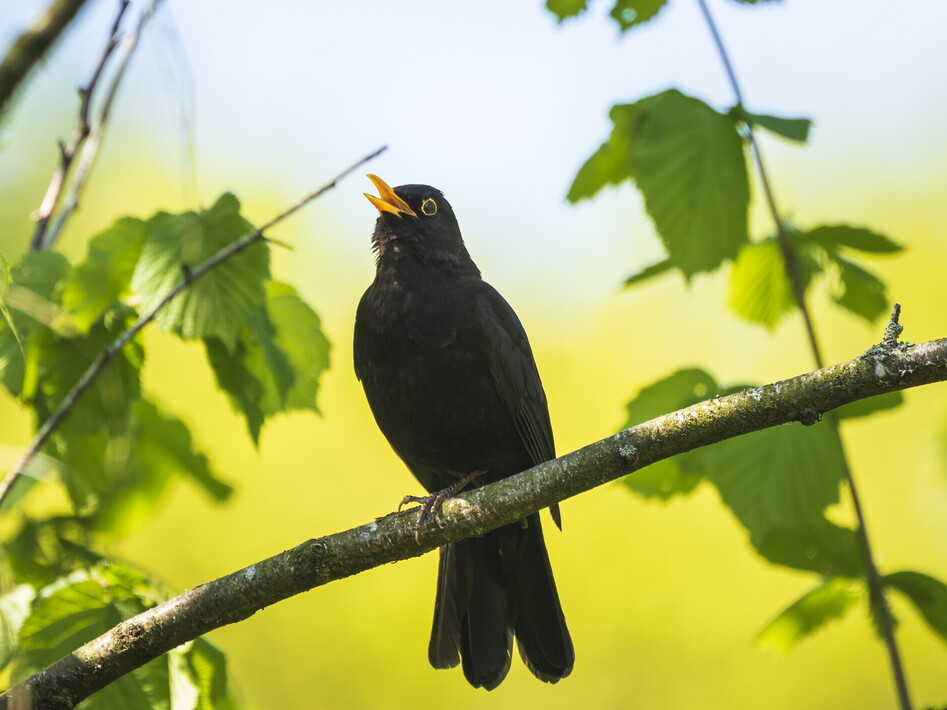
The researchers enlisted 84 adult volunteers (aged 19 to 81), who were invited into a quiet laboratory. Wearing headphones, each participant listened to short, 15-second recordings of vocalisations from 123 European bird species, played individually in random order, without knowing which species they were hearing. After each recording, participants rated the sound on a scale from 1 (not very pleasant) to 5 (very pleasant). It was no simple task: the scientists carefully measured all the "technical" features of each sound using professional software called Raven Pro, which can analyse a spectrogram, a graph showing how a sound's frequency (its pitch, or whether it is high or low) and amplitude (which relates to how loud or quiet it sounds) change over time. At the end of the experiment, the highest-rated sound was the song of the common blackbird (Turdus merula), a bird with a varied, melodious song that can easily be heard even in city gardens. The least popular sound, by contrast, was the call of the barn owl (Tyto alba), a nocturnal bird of prey known for its shrill, high-pitched screech, quite different from a melodic song. Analysing all the data, the researchers identified several characteristics that make a sound more pleasant to our ears: the best-liked sounds had relatively higher frequencies within the low-to-mid range (meaning they were neither too low-pitched nor excessively shrill), moderate volume (neither too quiet nor too loud), and a relatively narrow frequency range, meaning that the pitch did not vary too much within a single sound. By contrast, sounds with frequencies between 2,400 and 5,500 hertz (a range to which our ears are particularly sensitive) were perceived as more unpleasant, probably because we experience them as more intrusive and noisy. Finally, there was a surprising finding: more complex songs, featuring several different types of notes and sounds within the same recording, received higher ratings than monotonous, repetitive ones. Another interesting aspect of the research concerned the listeners themselves, rather than just the sounds. Participants were also asked how much they liked birds in general (for example, whether they found them attractive to look at or whether hearing their songs made them feel better) and how experienced they were at identifying birds by sight or sound. The result was clear: people who said they liked birds more tended to rate their songs as more pleasant, regardless of their technical knowledge. Being an expert birdwatcher, on the other hand - someone able to identify many different bird species - made no difference to how pleasant they found the sounds. This suggests that enjoying birdsong depends less on how much we know about birds than on how emotionally connected we feel to nature and animals in general. Nor did the researchers find any significant differences associated with participants' age or gender in their judgements of how pleasant the sounds were. The study is more than just a curiosity: the authors point out that understanding which acoustic characteristics make natural environments more relaxing could help improve the design of urban parks and green spaces, perhaps by encouraging the presence of bird species whose songs people find particularly pleasant and soothing. There is another interesting implication: when deciding which animals to prioritise for conservation, attention often goes to so-called "flagship species", animals that attract interest because of their appearance (think of pandas or tigers). According to researchers, an animal's sounds, not just its physical appearance, could also become an important criterion when choosing which species to highlight and promote in nature conservation campaigns. Next time you hear a bird singing during a walk, try asking yourself: is it high-pitched or low-pitched? Is it simple or full of different notes? According to this research, the answers may help explain, at least in part, why that particular song puts you in such a good mood.