


A hug to make peace
24 August 2026
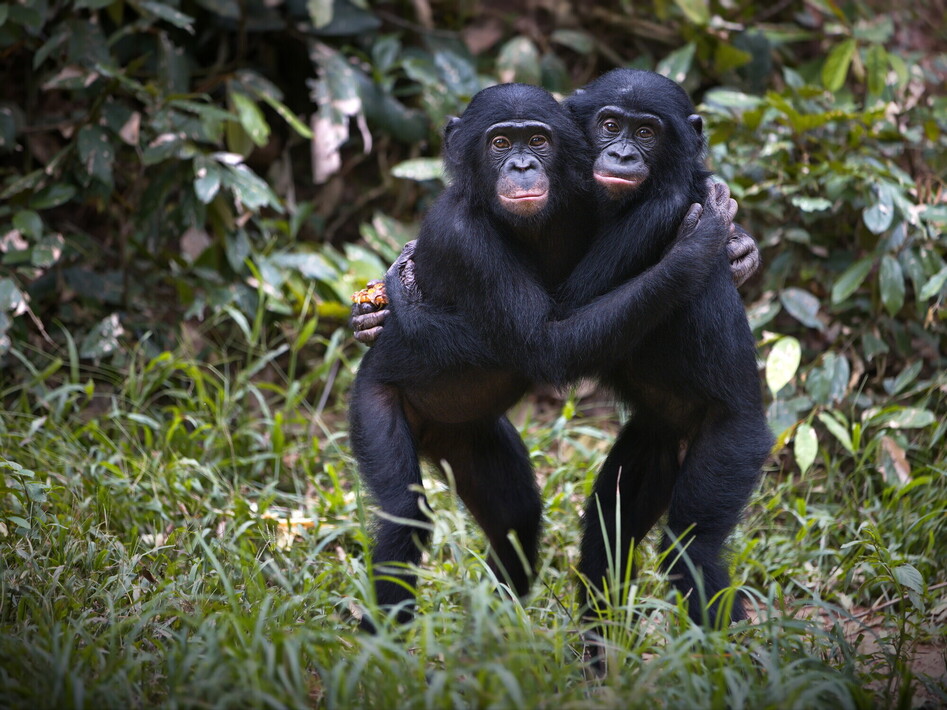

Imagine having to share a large box of sweets with all your classmates, knowing there will not be enough for everyone. Before you even began, there would probably be some tension: who gets there first, who takes more, who risks being left with none. Animals that live in groups face the same problem whenever food has to be shared. A group of scientists has discovered that our closest relatives in the animal kingdom, bonobos and chimpanzees, have found a surprising way to manage this tension: touching and hugging one another before eating.
Bonobos and chimpanzees are the two animal species most closely related to humans genetically. They live in large social groups in Africa and share a substantial proportion of their genetic heritage with us. Studying them also helps scientists gain a better understanding of human behaviour, as many of our social traits - including cooperation, friendship and even empathy - may have deep evolutionary roots that we share with these animals. The two species, however, are often thought to behave quite differently: bonobos are generally regarded as more peaceful and live in societies shaped largely by female leadership, whereas chimpanzees have a reputation for being more aggressive and male-dominated. Yet, as is so often the case, the reality is both more complex and more fascinating.
To investigate how these animals cope with competition for food, the researchers used a method known as the ‘peanut swing’. It works like this: a long bamboo container is filled with peanuts and attached to the mesh of the animals’ enclosure. Because the peanuts are released within a confined area, all the animals must gather at the same spot to feed - an ideal set-up for creating a little tension, much like a box of sweets being shared among classmates. Using multiple cameras, the researchers filmed five groups - three of bonobos and two of chimpanzees, comprising 124 animals in total - housed at two wildlife sanctuaries in Africa, one in the Democratic Republic of the Congo and the other in Zambia. Before the peanuts were distributed, the scientists closely monitored the animals’ behaviour during the five minutes leading up to feeding. The study’s main finding was clear: animals that exchanged more affectionate contact before feeding - through hugs, caresses or simply holding hands - were subsequently able to remain closer to the food more peacefully and with less conflict. In practice, a little ‘cuddling’ before the meal helped the whole group to be more tolerant during the most delicate phase, when the food began to run short. This behaviour, which the researchers call ‘reassurance’, works rather like two friends patting one another on the shoulder before a competition: it is a way of saying, ‘I am on your side; I do not want to fight with you.’ Another interesting finding concerns who reassures whom. Among bonobos, it is mainly females who exchange affectionate contact with one another before eating, behaviour consistent with the fact that, in this species, females often form very strong alliances with one another. Among chimpanzees, by contrast, the opposite occurs: males reassure one another more frequently, in keeping with the fact that, in this species, males often build lasting alliances. Curiously, these behaviours ‘typical’ of each species were clearly observed only in groups that were already more peaceful and tolerant. In the more ‘despotic’ groups, those with a more rigid hierarchy, even these bonds seemed to lose some of their effectiveness in calming tensions. Among chimpanzees, the researchers also observed a particular behaviour that bonobos never display: the ‘body kiss’ and the act of placing fingers or a hand in another individual’s mouth. It may sound strange, but it has a precise meaning: whoever does it voluntarily places themselves at risk, because a chimpanzee bite can be very dangerous. For that very reason, accepting this risk is a way of saying, ‘I trust you’, rather like a person placing themselves completely in a friend’s hands at a delicate moment. Unsurprisingly, this vulnerable and ‘courageous’ behaviour was observed mainly in the most tolerant chimpanzee group, the one in which social bonds were strongest. This study highlights something fundamental: harmony within a group does not arise on its own, but must be built and sustained through small, everyday gestures of trust and affection. It is not simply a matter of being more peaceful or more aggressive ‘by nature’; what truly matters is how individuals treat one another in moments of tension. Because bonobos and chimpanzees are our closest evolutionary relatives, researchers believe that our common ancestor, which lived more than six million years ago, may already have possessed the ability to use affectionate gestures to defuse social tension. In other words, when we make peace with a friend through a hug, or feel reassured by a pat on the shoulder before a school test, we may be drawing on an ancient social strategy rooted deep in our shared evolutionary history with these remarkable animals.