


Physics in football, science at the 2026 World Cup
12 June 2026
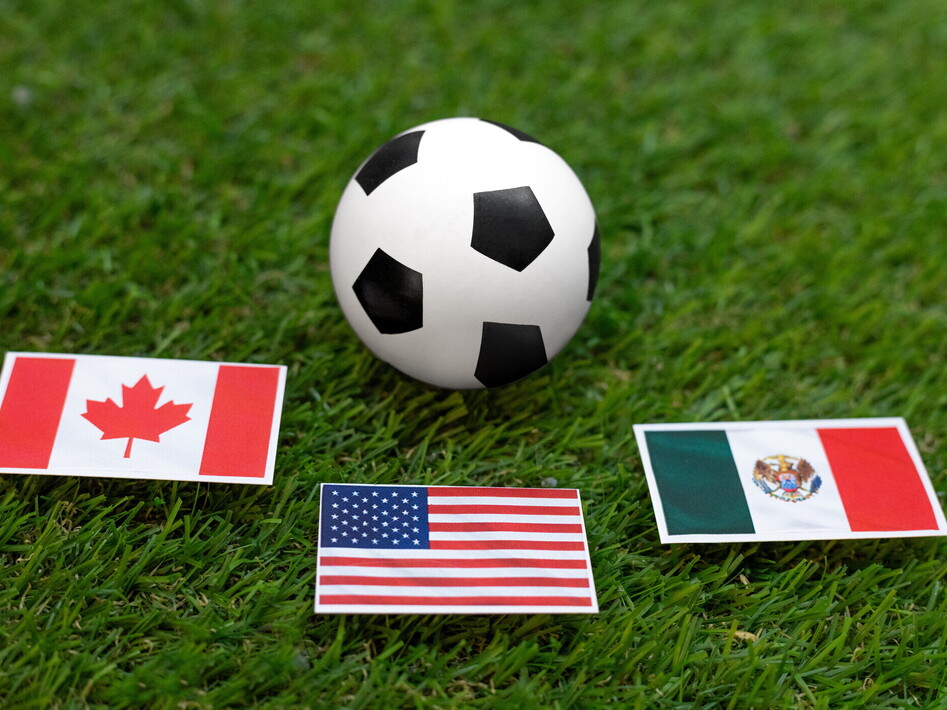

The 2026 FIFA World Cup began on 11 June with the opening match at the Azteca Stadium in Mexico City. Millions of fans watch the matches thinking about goals, dribbles and spectacular saves. But there is an invisible player that no one will ever see and yet that will influence every single ball kicked: the air.
Or rather, the lack of air. Mexico City lies at an altitude of over 2,200 metres. By way of comparison, Rome is practically at sea level, and the summit of the Gran Sasso, the highest mountain in the Apennines, is 2,912 metres high. The footballers playing at the Azteca find themselves a few hundred metres below that peak. And this changes everything. As altitude increases, the atmosphere “expands” and the molecules that make it up become more widely spaced. The air becomes less dense, that is, more rarefied. The percentage of oxygen in the air remains the same everywhere on Earth, at around 21%, but at 2,200 metres, each breath of air contains fewer molecules in total, and therefore fewer oxygen molecules too. At that altitude, a footballer sprinting breathes in about 15% less oxygen than a player running at the same pace at sea level. Fifteen per cent may not sound like much. But for a professional athlete running for ninety minutes, it is a huge difference. When we run, our muscles use glucose, a type of sugar found in the blood, to generate energy. Oxygen is essential to this process: the less of it reaches the muscles, the less efficiently they can work. During short, explosive sprints, such as a sudden burst of acceleration or a leap for a header, the body can manage even without much oxygen, drawing on its “emergency reserves”. The problem arises during recovery: after each sprint, the body needs to replenish those reserves, and it uses oxygen to do so. At altitude, this process is slower. The result? Footballers tire more quickly and take longer to recover between one effort and the next. Physiologists measure an athlete’s aerobic capacity using a parameter called VO₂ max, pronounced “V-O-two max”, which indicates the maximum amount of oxygen the body can use to produce energy. At high altitude, this value decreases. In practical terms, the footballer’s “engine” loses power. The effects are most noticeable in the second half of the match: players become less accurate, technical errors increase, and defensive recovery runs slow down. A team accustomed to pressing aggressively for the full ninety minutes may have to pace itself more carefully. This is not a new phenomenon. In 1968, Mexico City hosted the Olympic Games, and the results were extraordinary. In many explosive events, that is, events lasting only a few seconds, such as the pole vault, a host of world records fell. The most famous case is that of Bob Beamon, an American long jumper. In the Olympic competition on 18 October 1968, Beamon jumped 8.90 metres: a world record that improved on the previous mark by almost 55 centimetres. It was an astonishing distance, given that improvements in the long jump are usually measured in centimetres, or even millimetres. That Olympic record still stands today, almost sixty years later. How was this possible? Simple: in the thin air at altitude, Beamon’s body encountered less resistance while airborne. He “flew” further, exactly as a football does.
And here we come to the most fascinating point for anyone watching the matches. The ball is not merely an instrument of the game: it is a physical object governed by the laws of nature. And at altitude, those laws produce effects that are impossible to miss. When a footballer strikes the ball, the ball has to travel through the air. The air exerts a braking force on the ball, known as aerodynamic drag, which slows it down and alters its trajectory. At altitude, where the air is less dense, this drag is weaker. The result: the ball retains its speed for longer and travels greater distances. Long passes really do “carry” further. Crosses from the wing arrive with more force. Long-range shots are faster and can catch out the goalkeeper, who is used to certain flight times for the ball. Even the parabola, the curve traced by the ball in the air, changes slightly: the ball tends to follow a flatter, less arcing trajectory. Then there is an even more subtle phenomenon at play: the Magnus effect. When a footballer puts spin on the ball, making it rotate by striking it with the inside of the foot or with the instep, the ball curves. All great players do this to wrong-foot goalkeepers with unpredictable trajectories. At altitude, this effect changes too: the thinner air means that the ball bends in slightly different ways from those goalkeepers are used to. Not hugely different, but enough to make a difficult save even more difficult.
In South American football, there is one national team that has turned altitude into a genuine strategic weapon: Bolivia. The Bolivian team plays many of its home matches in La Paz, which stands at no less than 3,600 metres above sea level, far higher even than Mexico City. Playing against Bolivia in La Paz is regarded as one of the toughest challenges in South American World Cup qualifying. Teams accustomed to playing on lowland pitches arrive in Bolivia and, after twenty minutes, are already short of breath. The Bolivian players, by contrast, live there: over time, their bodies have adapted to using oxygen more efficiently. Statistical analyses show that this environmental factor really does affect results. This is not magic. It is science. Players cannot change the laws of physics, but they can prepare for them. Doctors and fitness coaches working with the major national teams study specific strategies to reduce the effects of altitude. One widely used method is to train at altitude before the competition. Spending several weeks above 1,500–2,000 metres pushes the body to adapt: the blood produces more red blood cells, the cells that carry oxygen, and the muscles learn to work more efficiently with less oxygen available. This process is called acclimatisation. There is, however, an interesting paradox: the first few days at altitude can be the worst. The body has not yet had time to adapt, and performance declines. For this reason, some teams choose the opposite strategy: arriving in Mexico City as late as possible, almost on the eve of the match, to limit exposure time before the benefits of adaptation begin to appear. Added to all this is an element of advanced technology. The official ball of the 2026 World Cup is called Trionda, a name that combines the Spanish words tri, meaning three, for the three host countries, Canada, Mexico and the United States, and onda. It is made by Adidas. Inside it is a small sensor chip that operates 500 times per second, or 500 Hz: it tracks the ball’s position, its speed, its direction and even the exact instant at which a player kicks it. These data are transmitted in real time to the referees and to the VAR system, which checks offsides and controversial incidents. In a match in which the ball flies faster than usual, having accurate millisecond-level data becomes even more important for making the right decisions. The story of the 1968 Mexico City Olympics and that of the 2026 World Cup remind us of something important: sport is not only about effort, technique and talent. It is also physics, chemistry and biology. Every time a footballer kicks a ball, they set in motion natural laws that physicists have been studying for centuries. The thin air at altitude is just one example. If you think about it, the material of the ball, the shape of the boots, the type of grass on the pitch, the temperature and the humidity of the air all influence what happens on the field. Today’s champions train with the help of scientists, doctors, engineers and mathematicians. Physics is not something that ends in the classroom when the bell rings: it is everywhere, even in a cross from the byline or a free kick. The next time you watch a World Cup match, remember this: alongside the twenty-two players on the pitch, there is a twenty-third unseen player. Its name is physics.
Sources: quotidiano.net, Wikipedia – Mondiali 2026, techprincess.it, sky sport