
A turtle’s life
14 July 2021
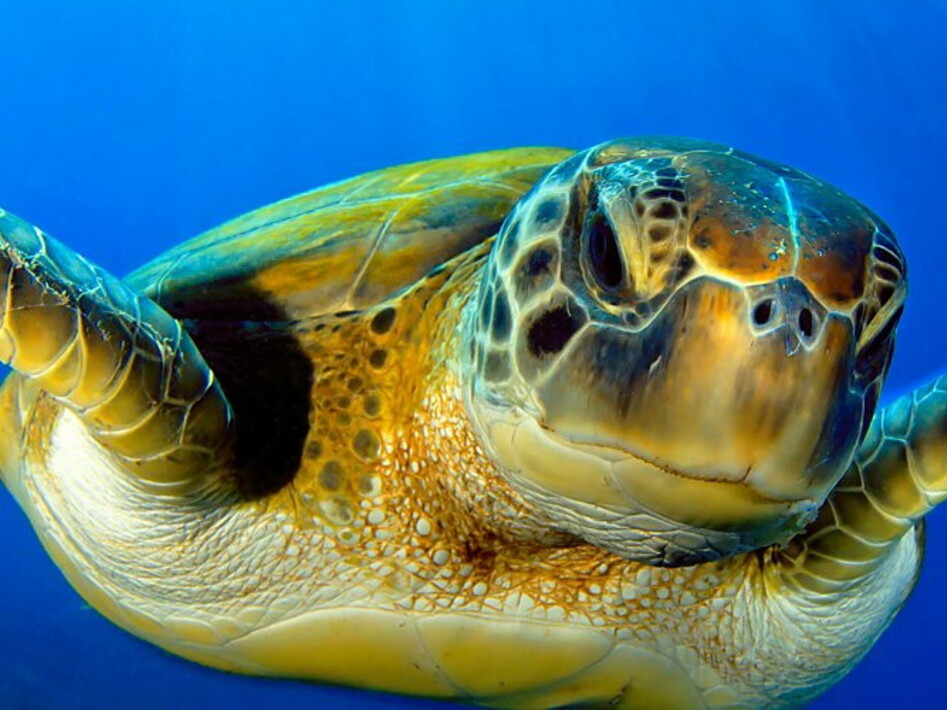

World Sea Turtle Day is held on 16 June. First established in 2008, the day is now supported by Sea Turtle Conservancy (STC), which campaigns for the survival of these animals. The day also commemorates Dr. Archie Carr, founder of STC and father of sea turtle biology. World Sea Turtle Day is celebrated on the same day as Dr. Carr’s birthday, 16 June, to honour his hard work to promote the sea turtle conservation movement as well as the scientific legacy he bequeathed to modern researchers. Let’s learn more about these fascinating marine animals and discover how to protect them!
A little marine biology…
Sea turtles are the oldest living reptiles today. They have been inhabiting the oceans for over 150 million years without having changed their physical appearance. Up to 200 years ago, millions of them populated the oceans’ waters: now they still inhabit the seas and oceans of our planet, but their number has dropped drastically over the past 100 years.
There are 7 species of sea turtles, all at risk of extinction: the leatherback turtle (Dermochelys coriacea), the green sea turtle (Chelonia mydas), the loggerhead turtle (Caretta caretta), the hawksbill turtle (Eretmochelys imbricata), Kemp’s ridley sea turtle (Lepidochelys kempii), the olive ridley sea turtle (Lepidochelys olivacea), the flatback sea turtle (Natator depressus). Of the seven species presently existing, the leatherback, the only one in its family, is the largest. Its carapace may grow to two metres in length and, on average, it weighs around 500 kilogrammes. Kemp’s ridley sea turtle, measuring 70 centimetres in length and weighing 50 kilogrammes, on the contrary, is the smallest.
Many aspects of turtle biology are still not very clear, mainly due to the difficulty of studying animals that live in the sea. For example, how sea turtles find their bearings on their long journeys across the oceans still remains largely a mystery.
Sea turtles love the sea so much that they leave it only to breed. In fact, despite the fact that they have adapted perfectly to marine life, every two or three years the females return to dry land to lay their eggs. Some cross whole oceans to do so, always returning to the same destination, that is the beach where they themselves were born (this is true for many species). Here they dig a hole in the sand where they lay from 50 to 200 eggs, depending on the species. The sex of the baby turtles is established by the temperature which, if higher than 29°C, determines the birth of more females than males.
If the nest is not raided, after about two months the baby turtles break the shells of the eggs and begin the difficult journey towards the water, during which they are easy prey to hungry birds and crabs. Precisely to increase their likelihood of survival, the baby turtles leave the nest only at night; they recognise the sea because it is more luminous and they run fast to reach it. Once they reach the sea, these little swimmers are at the mercy of predatory fish. Thus, on average, only one egg in 1000 becomes an adult turtle. If the nest is not raided, after about two months the baby turtles break the shells of the eggs and begin the difficult journey towards the water, during which they are easy prey to hungry birds and crabs. Precisely to increase their likelihood of survival, the baby turtles leave the nest only at night; they recognise the sea because it is more luminous and they run fast to reach it. Once they reach the sea, these little swimmers are at the mercy of predatory fish. Thus, on average, only one egg in 1000 becomes an adult turtle.
After spending several years in the open seas, the young of most of the species swim towards the coasts and begin living in the shallows since they are large enough to not have to fear the predators from which they escaped when they were young. These ancestral animals spend all their lives swimming alone in the sea, pairing up only for the purposes of mating. In fact, when they reach sexual maturity, estimated at between 15 and 30 years of age, turtles mate and the cycle begins again.
Local species of turtles
Three of the 7 known species of sea turtles are found in the Mediterranean. The most common in our seas is the Loggerhead turtle (Caretta caretta), while the Green sea turtle (Chelonia mydas) is less frequent and for climatic reasons prefers the Eastern Mediterranean coasts; the Leatherback (Dermochelys coriacea) appears only exceptionally in our seas and, unlike the other two, does not nest along the coasts of the Mediterranean.
Threats
From time immemorial, turtles have been used to reckoning with natural enemies. Later, as adults, only large sharks succeed in frightening them. Unfortunately, there are other real hazards today and, in fact, human activities threaten sea turtles every day.
Uncontrolled building along beaches, fishing, climate change and sea pollution threaten the survival of these animals. The growing demand for turtle meat, eggs and carapaces only further worsens the situation. Indeed, in many parts of the world turtles are still captured to be eaten or to sell parts of them as souvenirs, even though there are rigid protection laws, which in many countries are totally disregarded, by tourists too.
Human activities also have an impact on the laying of eggs. Hotels, bars and restaurants, roads, permanent beach facilities may indeed scare away any females who approach the coast to lay eggs. Once the eggs have been laid, disturbances and hazards do not end: beach umbrellas may damage the nest or, by creating shade, lower its temperature; mechanical sand cleaning equipment may pack down the sand above the nest, making it difficult for the baby turtles to come up to the surface; lights may confuse the little ones who instead of reaching the sea may be attracted elsewhere, for example to a road.
The greatest hazard, however, is posed by commercial fishing. Sea turtles are accidentally captured, remaining entangled in nets or they may swallow fishermen’s fishing lines. For this reason, many turtles drown, unless the fishermen immediately realise what has happened and go to their rescue. Each year, in the Mediterranean Sea alone, tens of thousands of turtles are captured by mistake. The fishing methods most hazardous for turtles are trot lines, trawl nets and fixed nets. A trot line is a heavy fishing line with a hundred or so baited hooks and it is the method that captures the greatest number of turtles. A trawl net is one that is dragged along the sea bed and, if the net is kept under water for long periods, any turtles caught in it may drown. The fishing method that causes the highest mortality amongst turtles is by nets, given that the net remains under water for many hours.
Lastly, sea pollution and, in particular, pollution deriving from refuse, above all plastic waste, cannot be forgotten. Turtles frequently ingest plastic bags floating in the sea, mistaking them for jellyfish, or plastic fragments, which create intestinal blockage or suffocation.
The result is that turtles are increasingly more threatened with extinction: human beings have determined a reduction of over 95% for some species and currently no less than six species out of seven feature in the IUCN red list of endangered species.
Let’s save turtles!
Turtles are essential for the well-being of the human population, for example, by eating jellyfish, they guaranteed the conditions necessary for the survival of shoals of fish and those required for summer seaside tourism. Fortunately, there are numerous projects, both in Italy and all over the world, that aim to protect sea turtles, by studying them, treating them at Recovery Centres and defending their nests. The purpose of these projects is to monitor, recover and rehabilitate turtles found in poor health or beached along the coasts and to reintroduce them into their natural habitat. Additionally, sea turtle recovery centres play an essential role in raising public awareness and providing environmental education, welcoming schools, groups, families and numerous tourists who, during the summer period, visit turtle hospitals.
The help given to sea turtles by recovery centres is not enough to protect sea turtles. Without commitment by all of us, these animals will continue to be increasingly threatened by extinction. It must be said that each of us can do something to protect these splendid and very important animals. Sharing beaches with turtles is easy, they do not ask much: just that they are not disturbed after sunset. We should not therefore go to the beach during the night, make noise, switch on lights or light fires in the vicinity. And we must not pollute the sea and beaches! We must always take our waste away with us, disposing of it correctly, and we must report polluted beaches. Thanks to Greenpeace and to the Plastic Radar campaign, launched on 1 June last year, it is possible to report the presence of plastic waste on beaches, sea beds or floating on the surface of Italian seas. Each of us can take part in the campaign by sending a message via Whatsapp or sending reports to number 342 3711267.
If someone asks you if you want to buy turtle shells, or live animals, refuse the offer and immediately report what has happened to the competent authorities.
Turtles sighted on the horizon…
During the summer months, seeing loggerhead turtles floating in the sea is not uncommon. These reptiles, which make long journeys during the winter in search of more temperate seas, in the summer love to rest in the sun on the surface of the water. Despite appearances, therefore, they are not always in difficulty. So when do you need to call in the authorities to rescue them?
Let’s look at possible causes for alarm:
- A nylon fishing line coming out of a turtle’s mouth may indicate that it has hooks in the mouth cavity and in the digestive tract.
- The presence of fishing nets, which may cause injury, mutilation or, in the worst cases, suffocation of the animal.
- The presence of plastic material protruding from its mouth or from its cloaca indicates ingestion of foreign bodies.
- Presence of evident wounds, often on its carapace or on its head. Usually these are due to collisions with motor boats. Wounds may also be due to being hit by a harpoon, deriving from incorrect use of underwater spear guns.
- Beaching of a sea turtle may mean that the animal is in difficulty. In fact, sea turtles return to land only to lay eggs.
In such cases, timely action is required, notifying the Harbour Office or the State Forestry Service by calling free phone number 1515. While waiting for the appropriate authorities to arrive, the animal must be kept in the shade, if possible, keeping it wet with a damp cloth (only the nostrils must remain open to allow breathing), avoiding sudden temperature changes. Once it has been handed over to the authorities, the turtle will be transferred to facilities where it can be treated.