
The secret of the giraffe’s long legs
09 December 2025
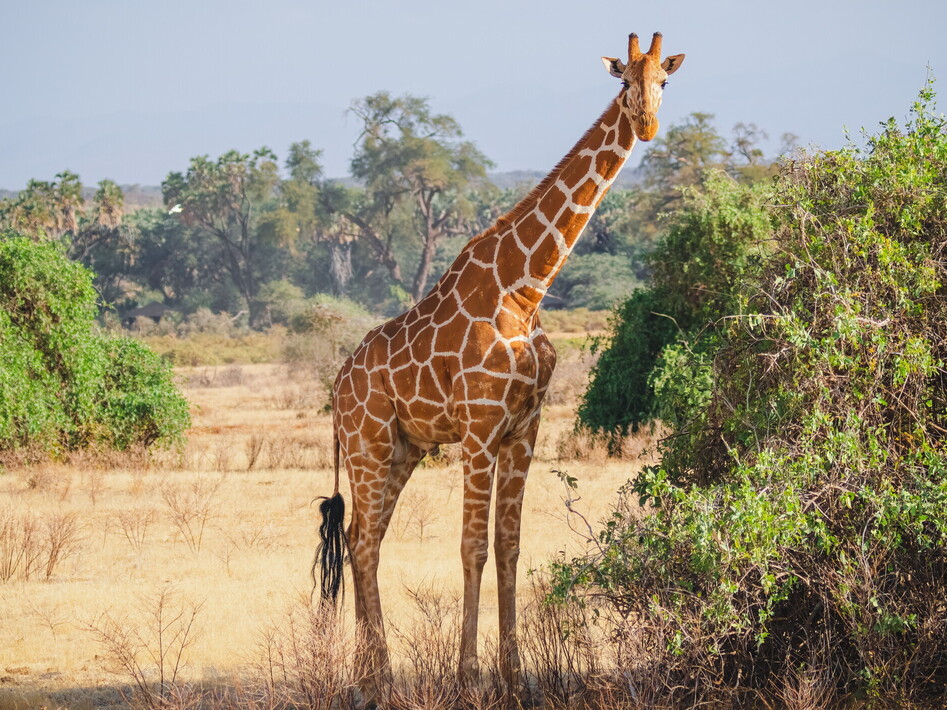

The giraffe’s extraordinarily long legs are not just tools for reaching leaves high up in the trees. According to recent research, they also play a crucial role in reducing the workload on the heart and making blood circulation more efficient.
A study conducted by the universities of Pretoria and Adelaide showed that, despite already standing on extremely long limbs, giraffes benefit from these elongated legs because they reduce the pressure the heart must generate to pump blood to the brain. Imagine a heart having to push blood to a point more than two metres above it: that is what happens in an adult giraffe. The vertical distance between heart and brain forces the animal to generate extremely high pressures to overcome gravity. Data collected in the study confirmed that giraffes have an average blood pressure much higher than that of most other mammals. This is where the long legs help: they raise the level of the heart relative to the ground, shortening the “column” of blood that has to be lifted up to the brain. In this way, the heart can “work” less and save energy. To test how different body proportions would affect this mechanism, researchers created a computer model of an imaginary animal they called the “elaffe” – a theoretical hybrid with the body of an eland antelope and the neck of a giraffe, but with shorter legs. The model was designed to explore what would happen if a giraffe had reached its height simply by lengthening its neck rather than its legs. The results were striking: in the model, the energy required by the heart increased remarkably compared with that of a real giraffe. In practice, by evolving long legs rather than an even longer neck, the giraffe saves a substantial amount of energy every day. What is the practical advantage? According to the study, long legs allow a giraffe to save around 5% of the energy that would otherwise be needed for the heart to pump blood to the brain. Over a year, this translates into tonnes of leaves the animal does not have to “burn” to support its cardiovascular system. In addition, long legs also increase the efficiency of movement: they help the animal cover ground more easily, using less energy per unit of body mass. Interestingly, fossil evidence suggests that giraffe ancestors evolved long legs before they evolved long necks. This indicates that developing long limbs was, from an energy standpoint, an “easier” evolutionary route than further lengthening the neck. Naturally, the “long legs plus long neck” configuration is not without drawbacks. Very long legs reduce agility and make some actions more difficult: for example, when a giraffe needs to drink, it has to splay its front legs awkwardly, adopting a highly vulnerable posture. In some situations, giraffes even choose not to drink rather than expose themselves too much. And despite their long legs, they cannot move the heart yet closer to the head. There are physiological limits: beyond certain thresholds of pulmonary pressure, serious problems would arise. This research shows how evolution, anatomy and physiology interact in surprising ways, and reveals that behind the seemingly simple image of an animal with a very long neck lies a delicate balance of opportunities and constraints.