
Secret chambers in the Pyramid of Menkaure
2 December 2025
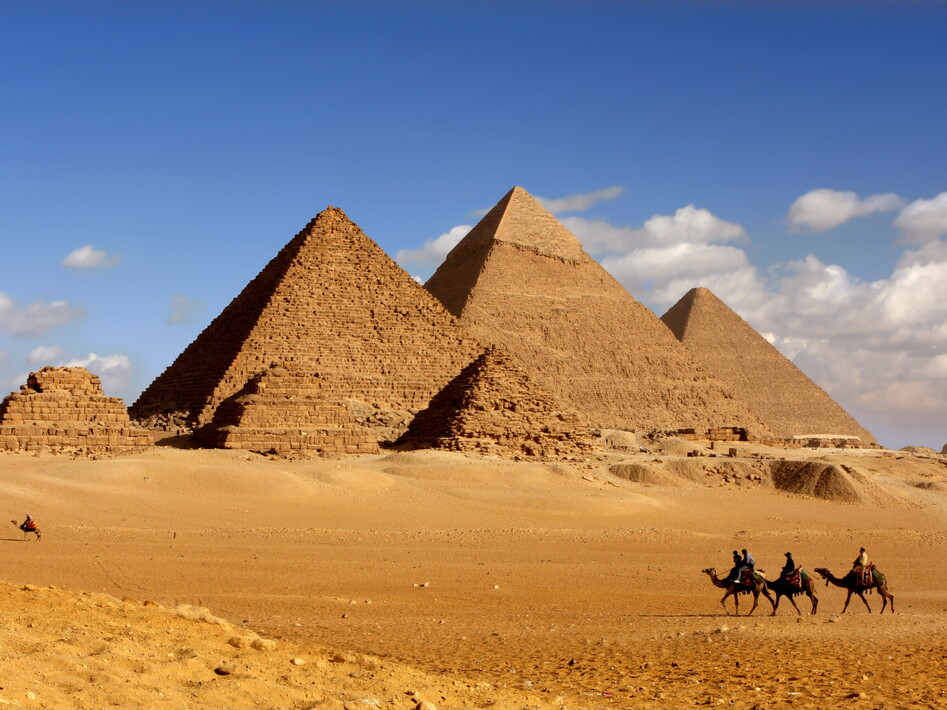

The study focuses on the Pyramid of Menkaure, the smallest of the three great pyramids on the Giza Plateau in Egypt. The authors examined the eastern side of the structure, along its polished granite façade, to test the hypothesis that there might be a secondary entrance.
To probe the interior of the pyramid without damaging it, they used three non-destructive techniques: electrical resistivity tomography (ERT), ground-penetrating radar (GPR) and ultrasonic testing (UST). Data from these techniques were then combined using a process known as “image fusion”, which overlays and correlates the results to produce a more reliable view of any anomalies. The results revealed two clearly identifiable anomalies behind the polished granite blocks of the eastern façade. These anomalies have been interpreted as possible air-filled cavities – empty spaces behind the outer wall. One cavity is located about 1.4 metres behind the façade and is estimated to be roughly 1.5 metres by 1 metre. The other lies about 1.13 metres deep, with dimensions of about 0.9 by 0.7 metres. The authors stress that these cavities have not been confirmed as corridors or chambers, but their presence makes it highly plausible that there could be a secondary entrance, or at least a hidden space, behind the eastern façade of the pyramid. The combined use of different techniques and the fusion of their images allowed for far greater precision in pinpointing these voids than would have been possible with any single method alone. This study marks a significant step forward in our understanding of the internal structure of the Pyramid of Menkaure. Although it does not yet offer definitive proof of a new entrance, it provides robust evidence of internal anomalies deserving further investigation. It also illustrates how modern technology can help us explore and understand ancient monuments without harming them.