


Deinosuchus: the “Terror Crocodile"
12 September 2025
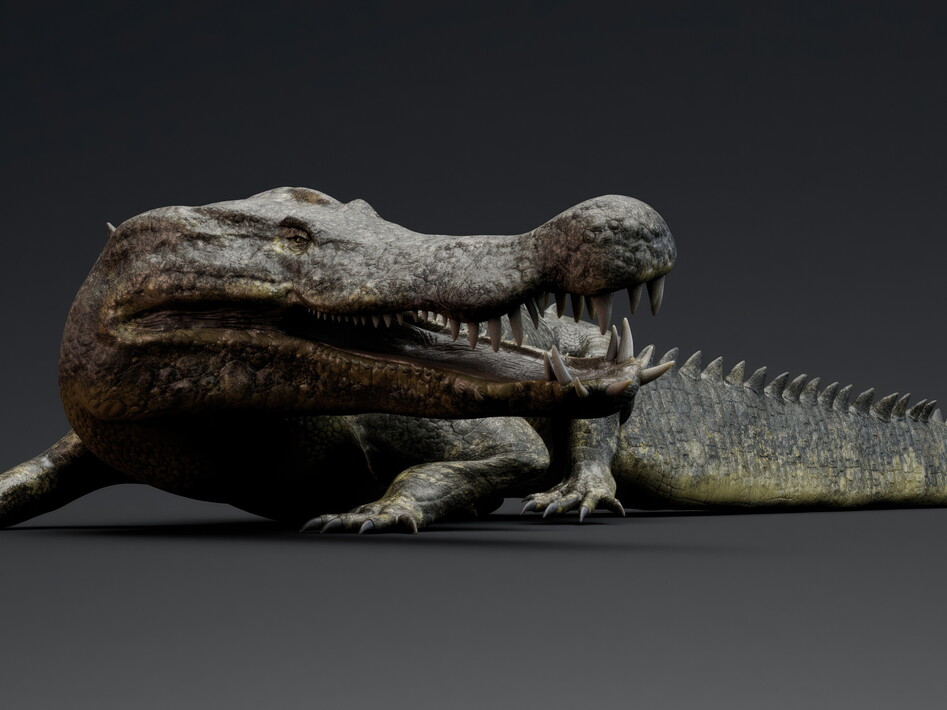

Deinosuchus, often nicknamed the “terror crocodile”, was a genus of giant crocodilians from the Late Cretaceous of North America. These imposing semi-aquatic predators dominated their environments around 75–82 million years ago, with individuals that could exceed 10 metres in length.
Their diet included large vertebrates, and there is fossil evidence that they even fed on dinosaurs. Deinosuchus fossils have been found across a wide area of North America - from northern Mexico to Montana in the west, and from the Mississippi to New Jersey in the east. This in-depth study outlines a crucial revision of their classification. Historically, three species of Deinosuchus have been recognised: D. hatcheri, D. rugosus, and D. riograndensis. However, their classification has long been problematic. New analyses have revealed key morphological differences among the species thanks to observations of the openings that lighten the skulls of these crocodilians. The gigantism of Deinosuchus suggests unique adaptations. Its large bony nasal openings, similar to those of other giant crocodilians such as Purussaurus, may have played a role in thermoregulation, helping these massive animals avoid overheating. The distinctive fenestrae on the snout of D. riograndensis may also have been involved in controlling body temperature via richly vascularised soft tissues connected to the respiratory system. The large cranial fenestrae—also common in other long-snouted forms—may have contributed to thermoregulation or to the power of the jaw muscles, ensuring greater speed and force when snapping shut.
Deinosuchus shares some cranial features with other long-snouted crocodilians, such as gharials, although it was a generalist predator rather than a fish specialist. This suggests that snout length in itself—regardless of the snout’s specific shape or the animal’s diet - imposed similar evolutionary constraints on these cranial structures. At that time, North America was split in two by the Western Interior Seaway, a vast body of salt water likely insurmountable for Deinosuchus (like modern alligatorids, they probably could not tolerate salt water for long), which functioned as a crucial geographical barrier. This isolation led ancestral populations in the east and west to evolve divergently, giving rise to distinct morphologies and body sizes—such as those observed between D. riograndensis (western) and D. schwimmeri (eastern). In summary, Deinosuchus remains one of the most fascinating giant alligatoroids. The research not only reinforces its identity as a “terror crocodile”, but also provides a clearer classification, allowing us to better appreciate the remarkable diversity and adaptations of these prehistoric predators.