


Virus life
18 May 2026
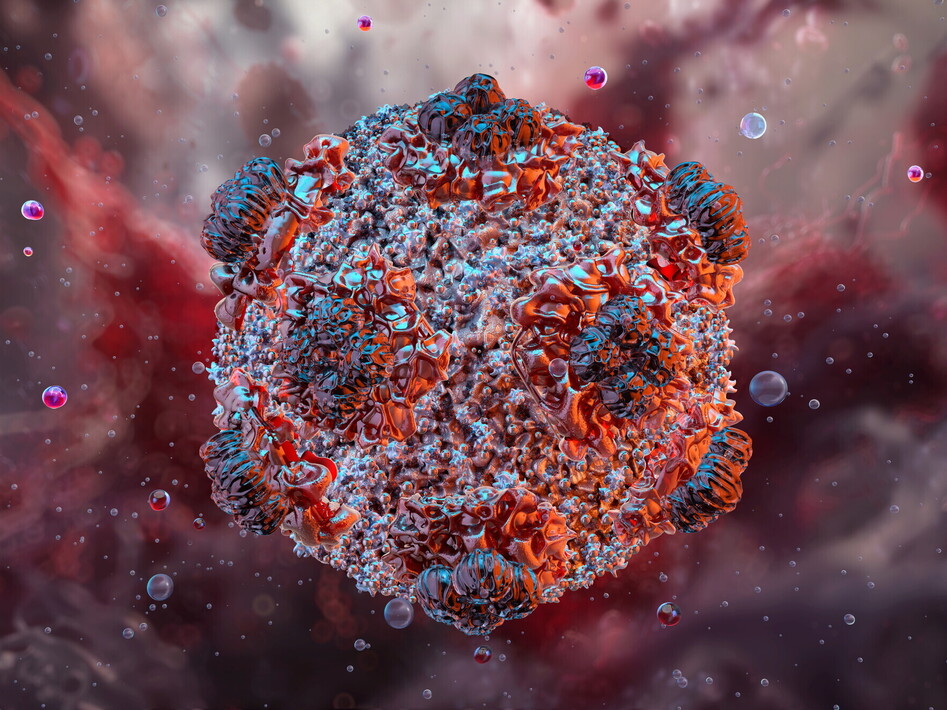

Hantavirus - a name largely unknown until only a few days ago - is now making headlines and reviving memories of the Covid-19 pandemic. Several weeks after the first reports emerged, the picture has become clearer, although it is, of course, still evolving. We now know with certainty that the strain involved in the case of the Dutch cruise ship MV Hondius is Andes: the only pathogenic hantavirus for which human-to-human transmission has been documented. Below, we explain what viruses are and how they spread.
What are viruses?
The word virus comes from Latin and means poison. Viruses do not eat, breathe, move or reproduce on their own. So, what kind of life is that? None: technically, viruses are not alive. A virus is a tiny box containing the instructions needed to make more tiny boxes just like itself. Each virus has its own distinctive shape: the measles virus is spherical, the influenza virus is a twenty-sided solid, the poliomyelitis virus and coronavirus resemble hairy little balls, while viruses that infect bacteria look like miniature spacecraft, complete with landing legs. Their structures vary, but they are all extremely small: the largest virus has a diameter of 300 nanometres, meaning that a row of 3,000 of these “giants” would measure just 1 millimetre. The smallest is only 20 nanometres across; it would take 50,000 of them lined up end to end to reach 1 millimetre.
How they reproduce
Viruses cannot reproduce on their own: to do so, they need to enter the cells of living organisms. Every organism has its own viruses: viruses that attack basil do nothing to us, and those that affect snails do not make humans ill. A virus can recognise its target cells and attack them. But how does it do this? Tiny proteins project from the surface of the cells of every living organism. Viruses carry proteins of their own and, when these fit perfectly with those on the cell surface - like a key fitting into a lock - the cell effectively lets the virus in. Once inside, the virus is broken down and its instructions are released. The cell itself then becomes a factory, assembling the components needed to create new viruses.
The next step for every newly formed virus is to leave the organism en masse and infect others. A virus is, in effect, programmed to multiply rapidly and spread as widely as possible, by any means available. Some, for example, make our noses itch to trigger sneezing, or make us cough so they can escape with the mucus. This is how the viruses responsible for influenza, Ebola, the common cold, smallpox, meningitis and poliomyelitis spread, as does COVID-19, the most recent of the coronaviruses. Other viruses pass from one organism to another through the exchange of bodily fluids, such as blood and saliva: this is the case with HIV, herpes and hepatitis C. Some hitch a ride on insects, such as the yellow fever virus, which uses mosquitoes. Other viruses spread through food, such as those that cause hepatitis A and E.
The immune system protects us from viruses
Our body’s immune system acts like a police force, constantly defending us against viral attacks. Lymphocytes are the security officers produced by the immune system: special cells that patrol the entire body through the blood and lymph and, when they catch viruses, produce antibodies.
Antibodies are proteins that latch on to viruses and neutralise them. They are like handcuffs, restraining the criminal before it can cause harm. By doing so, they prevent the virus’s proteins from fitting into those of the cell. Lymphocytes are highly skilled, but sometimes viruses move faster and still manage to make us ill.
Vaccines
Vaccines are a powerful weapon in our defence against viruses. Here is how they work. A vaccine contains only fragments of a virus. These fragments are not dangerous but, like police mugshots, they show lymphocytes what the culprits look like. Thanks to vaccines, lymphocytes already know the viruses’ “faces” and can prepare the right antibodies before the viruses themselves appear. If, later on, natural, active viruses of the same type attack the vaccinated organism, the immune system is already prepared to fight them.
The history of vaccines
The word vaccine clearly comes from vacca, meaning cow: vaccino can refer to milk or cheese obtained from cattle. But why does a medicine have the name of a yoghurt? Smallpox is a devastating viral disease that has killed millions of people worldwide. Edward Jenner, an English country doctor, observed around 1770 that milkers and cattle breeders did not contract smallpox. He discovered that the form of smallpox affecting cattle could be transmitted to humans but was not lethal, and realised that contact with infected animals might make people immune. He therefore injected infected serum from a bovine pustule into a young patient: the boy did not develop smallpox. After more than 20 years of study, this country doctor perfected an invention that has saved - and continues to save - billions of lives. Vaccines still bear this name today in memory of Jenner’s work. Thanks to vaccines, smallpox has been eradicated. The last case of poliomyelitis in Italy was recorded in 1982. That is worth remembering whenever we find ourselves questioning the importance of vaccines.
Zoonoses
Every virus has its natural home in a specific organism. Some viruses infect only tomatoes, others only horses, others only hens or only humans. Yet some viruses can leave one host behind and move into another. A disease that passes from animals to humans is called a zoonosis. Almost 60% of the pathogens that make humans ill are zoonotic. This coronavirus pandemic is one of them. The Ebola virus, for example, crossed from monkeys to humans. HIV, the virus that causes AIDS, was also present in African monkeys before it went on to kill 30 million people. Sometimes, before infecting humans, viruses pass through an intermediate animal: avian influenza viruses first circulated in chickens, then in pigs, and finally in humans. The Hendra virus is naturally at home in Australian bats, but it first infected horses, and then breeders. Zoonoses are hard to eradicate. Thanks to vaccines, the smallpox and poliomyelitis viruses - which infected only humans - have virtually disappeared worldwide. By contrast, we cannot know in advance which animal may be harbouring the virus behind the next zoonosis. A new one can always emerge… without warning.
What hantavirus is and how it is contracted
Hantaviruses are a family of RNA viruses found across the world and comprising many different strains. Only some of these, however, are pathogenic. They were first isolated in South Korea in 1978, when they were identified as the cause of Korean haemorrhagic fever, and they take their name from the Hantan River.
Based on their distribution, they are divided into New World hantaviruses, found in the Americas, and Old World hantaviruses, present in Asia and Europe - particularly in China and the Scandinavian countries. The former cause Hantavirus Pulmonary Syndrome and have a mortality rate that can exceed 40%; the latter more commonly cause Haemorrhagic Fever with Renal Syndrome, with a lower mortality rate. Hantaviruses, which belong to the Hantaviridae family, infect rodents, but only some of them are known to transmit infection to humans. Transmission occurs through contact with the urine, droppings or saliva of infected rodents; less frequently, infection can occur through the bite of an infected animal. People who work in agriculture or forestry are at greater risk, as are activities that may involve contact with rodents, such as cleaning enclosed, poorly ventilated spaces or spending time in environments infested by rodents.
Spillover
No living being is immune to viral attack, not even bacteria. Spillover is the natural phenomenon whereby a virus that infects animals changes, transforms and becomes capable of infecting humans. To understand how this happens, we need to return to the way a virus recognises a cell. If the virus’s proteins fit with those on the cell surface - like a key in a lock - infection will occur. But every cell has its own lock. This means that viruses with the right key to infect snail cells do not attack human cells, and vice versa. Viruses, however, reproduce rapidly and in vast numbers, so errors in the copying process can always occur. By chance, the “key” of an animal virus may change, transforming just enough to fit the “lock” on human cells. This happens more often with coronaviruses, which can more easily acquire the ability to pass from animals to humans. Most likely, Covid-19 originally came from a virus that normally infected bats. Spillover is more likely to occur where humans and animals remain in close, prolonged contact - for example, on large-scale farms or in places where wild animals are part of the human diet. The longer this contact continues, the greater the chance that a virus will change by accident and become dangerous to humanity.
Environmental degradation and the rise of new viruses
Most new viruses come from tropical forests. These are the richest and most complex environments on Earth in terms of living organisms. They are home to millions of different species - animals, plants, fungi and microorganisms, many of them still partly unknown - which harbour equally unknown viruses and parasites. As long as forests remain intact and healthy, viruses remain confined to the organisms that host them, as those organisms move undisturbed among the great trees. But when wildlife is killed and trees are felled to make way for roads, fields, timber, pastureland, mines and cities, viruses and other parasites lose their natural habitat. The further humans push into an environment and disrupt it, the greater the chance they will encounter unknown viruses and parasites. A parasite disturbed in its daily life and evicted from its usual host has only two options: disappear or, unfortunately for us, find a new home.